Validity Everest Review: Enterprise Inbox Placement and Reputation Monitoring

Pros
- Most comprehensive inbox placement monitoring available — real-time data across all major providers
- Sender reputation scoring provides a single metric for deliverability health
- Competitive intelligence shows how your placement compares to competitors
- Design testing previews email rendering across 100+ email clients and devices
- Built on Return Path's 20+ years of deliverability data and panel relationships
Cons
- Enterprise pricing starts well above $1,000/mo — inaccessible for small and mid-size senders
- Pricing is not transparent — requires sales conversations and custom quotes
- Complexity can overwhelm teams without dedicated deliverability expertise
- Onboarding and setup require significant time investment to configure properly
- Some features overlap with capabilities available in cheaper or free tools
What is Validity Everest?
Validity Everest is the enterprise benchmark for email deliverability monitoring. If you have worked in email deliverability at the enterprise level, you know the name — or at least its predecessor, Return Path, which pioneered the category of inbox placement monitoring in the early 2000s.
The lineage matters. Return Path spent two decades building panel-based inbox placement monitoring — a methodology where real consumer panelists allow their mailbox data to be anonymously observed, providing insight into where emails from specific senders actually land. This is fundamentally different from seed-based testing (used by GlockApps and others), which relies on test addresses rather than real recipients. Panel data captures real-world engagement signals and filtering behavior that seed addresses cannot replicate.
Validity acquired Return Path in 2019 and merged its deliverability tools into the Everest platform, combining inbox placement monitoring with sender reputation scoring, competitive intelligence, and design testing. The result is the most comprehensive deliverability monitoring platform available — and also the most expensive.
We have worked with Everest at the enterprise level and evaluated it against mid-market alternatives. This review covers the full feature set, the practical value proposition, and an honest assessment of whether the premium pricing is justified for different sender profiles.
Key Features We Tested
Inbox Placement Monitoring
Everest’s inbox placement monitoring uses a combination of panel data and seed testing to provide the most accurate picture of where your emails are landing. The panel data — drawn from millions of consumer mailboxes — shows real inbox placement rates at Gmail, Yahoo, Microsoft, and other providers without relying on test addresses.
This is Everest’s most significant differentiator. Seed-based testing (what GlockApps uses) sends your email to test addresses and checks delivery. The limitation is that test addresses have no engagement history with your brand — they have never opened, clicked, or replied to your emails. Since Gmail and other providers heavily weight engagement history in filtering decisions, seed addresses may see different placement than real subscribers.
Everest’s panel data captures what actually happens to real emails in real inboxes. The panel is large enough to provide statistically significant results across major providers, giving you confidence that the placement rates you see reflect what your subscribers experience.
The monitoring is real-time or near-real-time, meaning you see placement data as campaigns deploy rather than waiting for post-send test results. For high-frequency senders, this immediacy allows rapid response to placement drops before they affect an entire day’s sending.
Sender Reputation Scoring
Everest provides a proprietary sender reputation score that synthesizes multiple data points — inbox placement rates, complaint rates, spam trap hits, blacklist appearances, authentication status, and engagement metrics — into a single numerical score. The score tracks over time, showing reputation trends that correlate with deliverability outcomes.
The reputation score is useful as a health metric and early warning system. A declining score signals potential deliverability problems before they manifest as visible inbox placement drops. For deliverability teams managing multiple sending domains and IP ranges, the reputation dashboard provides a consolidated view of overall email health.
How much weight to give any single proprietary score is debatable — mailbox providers use their own internal models that no third party fully replicates — but Everest’s score is based on the deepest data set available outside of the providers themselves.
Competitive Intelligence
One of Everest’s unique features is the ability to see how your inbox placement compares to competitors. The panel data that powers placement monitoring for your emails also captures placement for other senders in the same category. This means you can see whether your inbox placement rate is above or below the industry average and how it compares to specific competitors (if they are large enough senders to appear in the panel data).
This competitive context is valuable for enterprise email teams that need to benchmark their performance and justify deliverability investments to leadership. Showing that your inbox placement at Gmail is 92% versus an industry average of 85% is a compelling data point. Showing that a competitor has 96% placement while you sit at 88% is an equally compelling argument for investment.
The competitive intelligence is not available at the individual-competitor level for smaller senders who may not have enough panel coverage. It works best for large consumer-facing brands in competitive categories like retail, travel, financial services, and media.
Design Testing
Everest includes email design testing that previews your email rendering across 100+ email client and device combinations — Gmail on Chrome, Outlook on Windows, Apple Mail on iPhone, Yahoo on Android, and many more. Each preview shows exactly how your email will look to the recipient, catching rendering issues before you send.
This feature competes with dedicated design testing tools like Litmus and Email on Acid. The integration into Everest means deliverability teams can test both placement and rendering in a single platform rather than juggling separate tools. The rendering coverage is comprehensive, though dedicated design testing tools may offer slightly more device combinations and more frequent client updates.
For teams already paying for Everest, the bundled design testing eliminates the need for a separate Litmus or Email on Acid subscription — a meaningful cost savings given that those tools run $80-150/month on their own.
DMARC Analytics
Like GlockApps and MxToolbox, Everest includes DMARC report aggregation and analysis. The DMARC dashboard visualizes authentication results across sending sources, helps identify unauthorized senders, and provides guidance for moving toward DMARC enforcement.
Everest’s DMARC analytics are competent but not dramatically different from what GlockApps or MxToolbox offer in this category. If DMARC analytics is your primary need, you can get equivalent functionality for far less money. The value of Everest’s DMARC features is their integration with the broader deliverability dashboard — authentication data alongside placement data alongside reputation data creates a complete picture.
Pricing Breakdown
Validity does not publish Everest pricing publicly. This is standard for enterprise SaaS products but frustrating for buyers evaluating options. Based on our industry knowledge and conversations with current customers:
- Entry-level Everest: Typically $1,000-1,500/month for basic inbox placement monitoring, reputation scoring, and a limited number of monitored domains/IPs
- Mid-tier Everest: $2,000-3,500/month for full placement monitoring, competitive intelligence, design testing, DMARC analytics, and moderate domain coverage
- Enterprise Everest: $4,000-5,000+/month for unlimited monitoring, API access, dedicated account management, custom reporting, and advanced competitive intelligence
Annual contracts are standard, and Validity typically requires a 12-month commitment. Some flexibility on pricing may be available for multi-year deals or organizations that also use Validity’s other products (BriteVerify email verification, DemandTools data management).
The pricing is appropriate for the value delivered to enterprise email programs. An ecommerce brand sending 50 million emails per month that improves inbox placement by 3% through Everest-informed optimization could see revenue gains that dwarf the subscription cost. The challenge is that this ROI calculation only works for high-volume senders with significant email revenue.
Who It’s Best For
Enterprise email programs with dedicated deliverability teams. If your organization has one or more people whose job is email deliverability, Everest is the primary tool they should be using. The depth of placement data, reputation monitoring, and competitive intelligence is unmatched.
High-volume senders (5 million+ emails/month) where inbox placement directly impacts revenue. Ecommerce, financial services, travel, media, and SaaS companies that generate measurable revenue from email benefit most from the granular visibility Everest provides.
Organizations managing complex sending infrastructure with multiple domains, IP ranges, and sending services. Everest’s consolidated dashboard provides a single view of deliverability health across the entire sending ecosystem.
Marketing agencies managing deliverability for enterprise clients can justify Everest’s cost when spread across multiple client accounts. The competitive intelligence and benchmarking features are particularly valuable in agency contexts where demonstrating performance against industry standards is part of the client relationship.
For senders doing under 1 million emails per month, Everest is almost certainly more tool than you need and more expense than you can justify. Start with our free Deliverability Tester — it covers inbox placement simulation, SPF/DKIM/DMARC validation, blacklist checks across 14 DNSBLs, and content analysis in a single free tool. Our individual tools (SPF Checker, DMARC Checker, Blacklist Checker, Deliverability Score cover foundational diagnostics at no cost. GlockApps ($79-399/month) fills the gap for mid-market senders who need scheduled provider-level placement testing beyond what free tools offer. ZeroBounce handles list verification. Together, these tools provide 80% of what Everest offers at a fraction of the cost.
Limitations
Price is the obvious limitation. At $1,000+ per month, Everest is inaccessible to the vast majority of email senders. This is by design — Validity explicitly targets enterprise buyers — but it means the best deliverability monitoring tool available is only available to organizations with enterprise budgets.
Pricing opacity adds friction to the buying process. Requiring sales conversations and custom quotes before you know whether the product fits your budget wastes time for both buyers and sellers. A published pricing page with clear tier definitions would serve the market better, even if final pricing remains negotiable.
Complexity is a genuine concern. Everest provides a tremendous amount of data, and without deliverability expertise, much of it is noise. The platform assumes its users understand concepts like IP warm-up curves, reputation feedback loops, complaint-rate thresholds, and engagement-based filtering. For teams without dedicated deliverability expertise, simpler tools with more guidance may produce better outcomes.
Onboarding takes time. Configuring Everest to monitor your full sending infrastructure — domains, IPs, authentication, sending services, DMARC reporting — is not a quick setup. Expect 2-4 weeks of configuration and integration before the platform is providing full-fidelity data. This is not a tool you can sign up for on Monday and use on Tuesday.
Panel data coverage varies by provider and geography. Gmail and Microsoft have strong panel representation. Smaller providers, regional services, and B2B email environments may have limited or no panel coverage. For senders whose audience is concentrated in under-represented segments, the placement data may be incomplete.
Bottom Line
Validity Everest is the most comprehensive email deliverability monitoring platform available. The combination of panel-based inbox placement data, sender reputation scoring, competitive intelligence, and design testing creates a depth of visibility that no other product matches. For enterprise email programs where deliverability is a revenue driver and a dedicated team manages the sending infrastructure, Everest is the standard tool.
The enterprise pricing and complexity mean this is not for everyone — and that is fine. The deliverability monitoring market is well-served at every price point. Start with our free Deliverability Tester for a comprehensive 12-point analysis — inbox placement simulation, SPF/DKIM/DMARC validation, blacklist checks, and content analysis, all free with no account required. From there, graduate to GlockApps for periodic provider-level placement testing or ZeroBounce for list cleaning, and consider Everest when your email volume and revenue justify the investment. The right tool is the one that matches your needs and budget, and Everest is the right tool for the enterprise tier.
Our Verdict
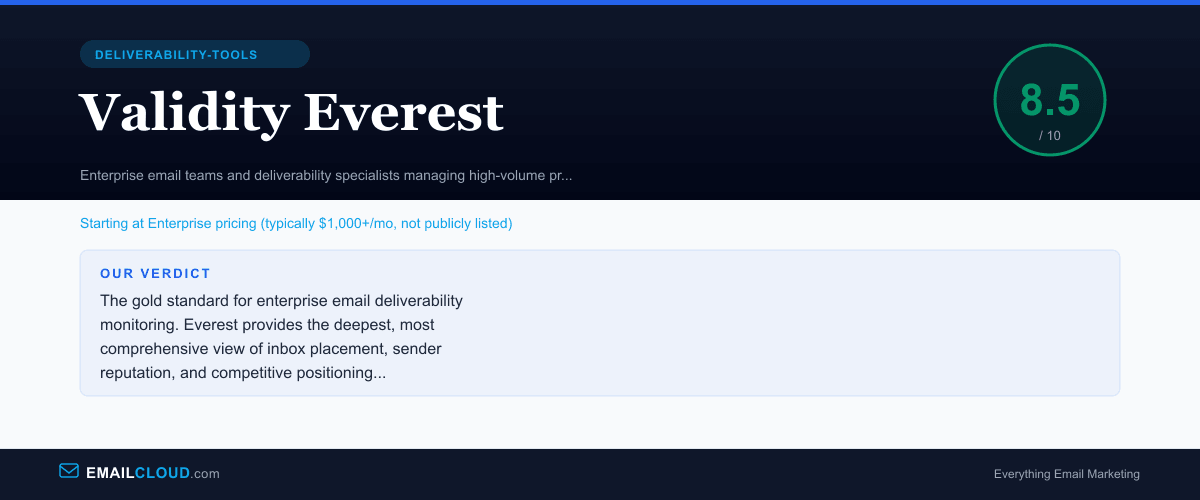
The gold standard for enterprise email deliverability monitoring. Everest provides the deepest, most comprehensive view of inbox placement, sender reputation, and competitive positioning available anywhere. The price tag is enterprise-grade too — this is not for small or mid-size senders. For organizations with dedicated deliverability teams and significant email revenue, it is an essential investment.
Review Summary
Share this visual summary. Right-click to save.
Frequently Asked Questions
What is Validity Everest?
Validity Everest is an enterprise-grade email deliverability platform that combines inbox placement monitoring, sender reputation scoring, competitive intelligence, and design testing into a unified dashboard. It is the successor to Return Path, which was the original inbox placement monitoring service. Validity acquired Return Path in 2019 and consolidated its deliverability tools under the Everest brand. The platform provides real-time visibility into where your emails land across providers, how your sender reputation compares to industry benchmarks, and how your deliverability stacks up against competitors.
How much does Validity Everest cost?
Validity does not publish Everest pricing on its website. Pricing is custom and requires a sales consultation. Based on industry reports and our discussions with current users, entry-level Everest subscriptions typically start above $1,000 per month, with enterprise configurations ranging from $2,000 to $5,000 or more per month depending on sending volume, number of monitored domains, and feature set. Annual contracts are standard. This pricing reflects the platform's position as an enterprise tool — it is designed for organizations where email generates significant revenue and deliverability directly impacts the bottom line.
How does Validity Everest compare to GlockApps?
Everest and GlockApps both provide inbox placement testing, but they serve different market segments. GlockApps is a mid-market tool starting at $79/month that provides solid inbox placement testing and DMARC analytics. Everest is an enterprise platform at $1,000+/month that adds real-time monitoring (not just periodic testing), sender reputation scoring, competitive intelligence, and design testing. For senders doing under 500,000 emails per month, GlockApps provides sufficient placement visibility at a fraction of the cost. For enterprise programs with millions of monthly sends and dedicated deliverability teams, Everest's depth and real-time capabilities justify the premium.
Is Validity Everest worth the price?
For enterprise email programs where deliverability directly impacts revenue — ecommerce brands, financial services, SaaS platforms with large user bases — Everest can pay for itself many times over. A 5% improvement in inbox placement on a 10-million-email program can represent hundreds of thousands of dollars in additional revenue. For those organizations, $1,000+/month for real-time deliverability intelligence is a rounding error. For smaller senders, the cost-benefit calculation does not work. Start with our free Deliverability Tester at /delivery-check for a comprehensive 12-point analysis including inbox placement, authentication, and blacklist checks. Then GlockApps and ZeroBounce can cover mid-market monitoring and list verification at a fraction of Everest's cost.
Stay ahead of the inbox
Weekly tips on deliverability, automation, and growing your list. No spam, ever.
No spam. Unsubscribe any time. We respect your inbox.