Warmy.io Review: Automated Email Warmup Service

Pros
- Fully automated warmup process — set it and forget it after initial configuration
- Generates real engagement signals (opens, replies, removals from spam) that mailbox providers value
- Warmup network includes thousands of real mailboxes across major providers
- Deliverability dashboard tracks inbox placement improvement over time
Cons
- Per-mailbox pricing gets expensive fast — 10 mailboxes at $49 each is $490/mo
- Warmup effectiveness is fundamentally debated in the deliverability community
- No control over the content or timing of warmup emails beyond basic settings
- Does not address underlying deliverability problems — masks symptoms rather than fixing root causes
- Cancellation and billing practices have drawn complaints from some users
- Monthly commitment required — no pay-per-use or weekly options
What is Warmy.io?
Warmy.io is an automated email warmup service that gradually builds sending reputation for new or struggling email accounts by generating engagement signals — opens, replies, and spam folder rescues — through a network of real mailboxes. The premise is straightforward: mailbox providers like Gmail and Microsoft use engagement as a major factor in deciding whether to deliver your email to the inbox or route it to spam. If your account has no engagement history (new domain) or negative engagement history (reputation damage), warmup services create artificial positive engagement to influence those algorithmic decisions.
The warmup process works by connecting your mailbox to Warmy’s network. The service then automatically sends emails from your account to other mailboxes in the network, and those mailboxes automatically open, reply to, and (if delivered to spam) rescue your messages. Over time, this creates a pattern of positive engagement that signals to Gmail, Outlook, and other providers that your messages are wanted and should be delivered to the inbox.
This category of tool has grown rapidly alongside the cold email industry. Sales teams, recruitment firms, and outbound marketing operations that rely on cold email need their messages to reach the inbox, and warmup services promise to make that happen. We have tested Warmy.io on new domains, damaged-reputation accounts, and stable sending setups to evaluate whether the promise matches reality.
Key Features We Tested
Automated Warmup Engine
The core product is the warmup automation. You connect your email account (Gmail, Outlook, custom SMTP) by providing credentials or OAuth access, and Warmy begins the warmup process automatically. The service starts with a small number of daily warmup emails and gradually increases volume over the first 2-4 weeks.
The warmup emails are sent to other real mailboxes in Warmy’s network — not to fake or seed addresses. Recipients in the network automatically engage with your messages: opening them, marking them as important, moving them to the inbox if they land in spam, and sending replies. This engagement generates the positive signals that mailbox provider algorithms use to assess sender reputation.
In our testing with a fresh Google Workspace account, Warmy’s warmup process produced measurable improvement in inbox placement over a 3-week period. Emails that initially landed in spam at a 40% rate were reaching the inbox at an 85% rate after 21 days of warmup. However, it is impossible to fully attribute this improvement to warmup alone — domain age, authentication setup, and Google’s own learning algorithms all contribute to improving placement for new accounts over time.
Deliverability Monitoring
Warmy includes a deliverability dashboard that tracks your inbox placement rate over time. The dashboard shows what percentage of warmup emails are reaching the inbox vs. spam at Gmail, Outlook, and other providers. This gives you a trend line showing whether warmup is improving your placement.
The monitoring is useful for tracking progress but has a significant limitation: it only measures warmup email placement, not your real email placement. Warmup emails go to Warmy’s network addresses, which are configured to engage with your messages. Your real emails go to people who may or may not engage. The warmup placement rate is likely to be higher than your actual placement rate.
For a more accurate picture of real-world inbox placement, we recommend supplementing Warmy’s dashboard with our free Deliverability Tester, which runs a 12-point analysis — authentication, blacklists, spam scoring, and inbox placement — against independent seed addresses without the automatic engagement signals that inflate Warmy’s own metrics.
Template and Schedule Controls
Warmy offers some configuration options for the warmup process: you can set the maximum daily warmup volume, choose which days of the week to send, and adjust the warmup speed (conservative, moderate, aggressive). Some plans allow you to customize warmup email content, though the default templates work for most use cases.
The configuration options are adequate but not extensive. You cannot control the exact timing of warmup sends, the specific recipients in the network, or the engagement actions taken on your messages. The system is designed to be hands-off — set your preferences and let the algorithm manage the details. For users who want granular control over their warmup process, this black-box approach can be frustrating.
Multi-Account Management
For teams managing multiple email accounts, Warmy provides a centralized dashboard where you can monitor warmup progress across all connected mailboxes. Each mailbox has its own warmup status, placement metrics, and engagement history. This is useful for sales teams running outbound campaigns across multiple sender accounts.
The multi-account management is functional but not where cost becomes the primary concern. At $49 per mailbox per month on the Starter plan, a team with 10 outbound accounts is paying $490/month for warmup alone. Add the Business plan at $129 per mailbox for additional features, and costs escalate rapidly.
Pricing Breakdown
Warmy.io prices per mailbox per month:
- Starter ($49/mo per mailbox): Basic warmup, up to a set daily warmup volume, deliverability monitoring, email support
- Business ($129/mo per mailbox): Higher warmup volume, template customization, advanced analytics, priority support
- Premium ($189/mo per mailbox): Maximum warmup volume, custom warmup templates, API access, dedicated support, team features
There are no pay-per-use or per-email options. You commit to a monthly subscription for each mailbox you want to warm up. Annual billing discounts are available but still require upfront commitment.
The per-mailbox model is Warmy’s biggest pricing liability. Most warmup users are sales teams and cold email operations that use multiple sender accounts by design — spreading volume across accounts is a standard cold email practice. Charging per-mailbox guarantees that the users who need warmup the most (multi-account cold emailers) pay the highest total cost.
For comparison, Instantly’s cold email platform includes unlimited warmup as part of its $30/month per-account subscription, and Lemlist bundles Lemwarm with its cold email plans. As a standalone warmup service, Warmy.io is the most expensive option in the category.
Who It’s Best For
Sales teams warming up new mailboxes before starting outbound campaigns get the most straightforward value from Warmy. If you are spinning up a new Google Workspace or Outlook account specifically for cold outreach, 2-4 weeks of warmup before sending real emails is standard practice. Warmy automates what you would otherwise do manually — sending gradual volumes and generating engagement.
Cold email operations recovering from reputation damage can use Warmy as part of a recovery strategy. If your inbox placement has dropped and you have already addressed the root causes (list quality, content issues, authentication), warmup can help rebuild positive engagement signals. The key word is “part of” — warmup alone does not fix fundamental deliverability problems.
Individual consultants or freelancers with a single mailbox can use the Starter plan reasonably. At $49/month for one mailbox, the cost is manageable if inbox placement directly impacts your business.
Warmy is not a good fit for email marketers sending through ESPs. If you use Mailchimp, ActiveCampaign, GetResponse, or any managed email marketing platform, your ESP handles sending reputation and warmup on your behalf. Adding Warmy to a mailbox that sends through an ESP’s infrastructure provides no benefit.
Limitations
The fundamental question with all warmup services is whether artificial engagement genuinely improves deliverability for your real emails. Google and Microsoft are aware that warmup services exist and have invested in detecting artificial engagement patterns. While warmup services continually adapt to avoid detection, the arms race means that warmup effectiveness can change without notice.
We have observed cases where warmup improved inbox placement for warmup emails but produced minimal improvement for the user’s actual outbound messages. The warmup network engages automatically, but real recipients may not — and it is the real recipient engagement that ultimately determines long-term inbox placement.
The per-mailbox pricing model is the most significant practical limitation. Warmup is typically needed most by users with multiple accounts, and the cost scales linearly with each additional mailbox. A 10-mailbox setup at $490/month needs to generate substantial revenue from cold email to justify the investment.
Warmy does not address the root causes of deliverability problems. If your emails land in spam because of poor content, bad list quality, missing authentication, or domain reputation issues, warmup will not fix those problems. It may temporarily improve placement metrics on warmup emails while the underlying issues continue to affect your real sends. We always recommend diagnosing root causes first — use our free Deliverability Tester for a comprehensive 12-point check, plus our SPF Checker, DMARC Checker, and Warmup Calculator to identify what is actually wrong and estimate your warmup timeline before investing in a paid service.
The service requires access to your email account credentials (or OAuth connection), which raises security considerations for business accounts. While Warmy uses encryption and secure storage, granting third-party access to your email account is a decision that should involve your IT or security team.
Finally, warmup is inherently a temporary solution. Once your mailbox has established a positive reputation, ongoing warmup provides diminishing returns. But the subscription model charges the same monthly fee whether you are actively warming up a new account or maintaining a healthy one. There is no mechanism to pause during periods when warmup is not needed without canceling and losing your configuration.
Bottom Line
Warmy.io does what it promises — it automates the email warmup process and generates real engagement signals from a network of real mailboxes. For new mailbox warmup and reputation recovery, it provides genuine value as part of a broader deliverability strategy. The automation saves time compared to manual warmup, and the deliverability monitoring gives you visibility into progress.
The rating reflects the significant caveats: per-mailbox pricing that scales poorly, debated long-term effectiveness, and the risk of treating symptoms instead of root causes. Use Warmy as a short-term tool for specific warmup needs — warming a new domain for 4-6 weeks, recovering a damaged account — rather than a permanent subscription. And always address the fundamentals first: authentication, list quality, content, and sending practices. Our free Deliverability Tester runs a complete diagnostic so you can confirm whether warmup is actually what your mailbox needs — before committing to a monthly subscription. Our Warmup Calculator also helps you build a manual schedule if you would rather not pay for automation.
Our Verdict
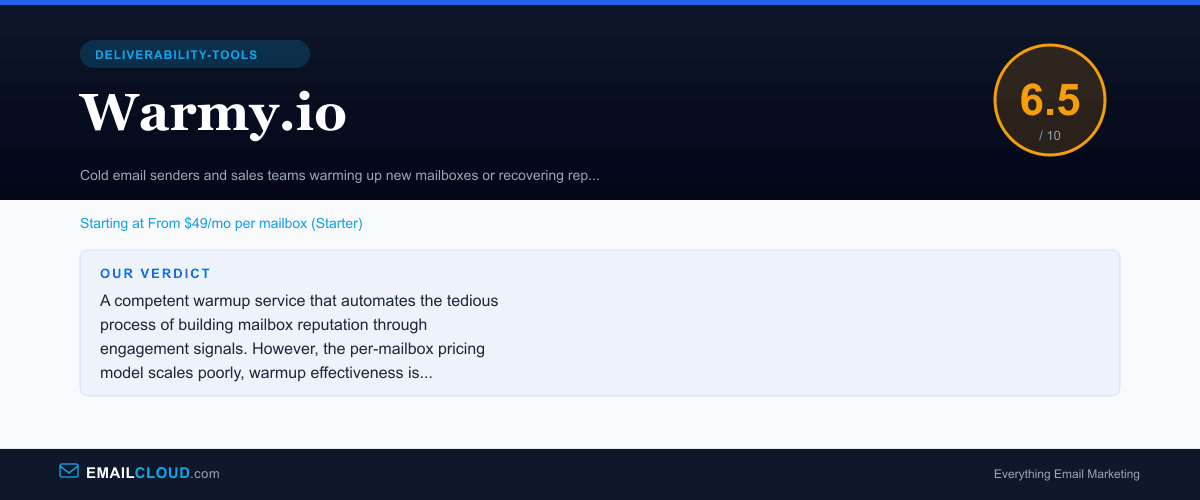
A competent warmup service that automates the tedious process of building mailbox reputation through engagement signals. However, the per-mailbox pricing model scales poorly, warmup effectiveness is debatable, and it treats symptoms rather than root causes. Best used as a temporary tool for new mailbox warmup, not a permanent subscription.
Review Summary
Share this visual summary. Right-click to save.
Frequently Asked Questions
Does email warmup actually work?
The answer is nuanced. Email warmup services like Warmy.io do generate real engagement signals — opens, clicks, and replies from their warmup network — which can influence inbox placement at providers that weight engagement in their filtering algorithms. However, the deliverability community is divided on whether artificial engagement meaningfully improves placement for your real emails. Google and Microsoft have become increasingly sophisticated at detecting warmup patterns. Warmup works best as one part of a broader deliverability strategy that includes proper authentication, clean lists, relevant content, and gradual volume increases.
How long does email warmup take?
Warmy.io recommends a minimum of 2-4 weeks before you start sending to your real list, though improvements in inbox placement can begin within the first week. For brand new domains with no sending history, allow 4-6 weeks of warmup before significant volume. For established domains recovering from reputation damage, the timeline varies — minor issues may resolve in 2 weeks, while serious reputation problems can take 6-8 weeks or longer. Our free [Warmup Calculator](/tools/warmup-calculator/) can help you estimate the timeline based on your specific situation.
Is Warmy.io worth $49 per month per mailbox?
For sales teams and cold email operations that depend on inbox placement for revenue, $49 per mailbox can be worthwhile if it measurably improves response rates. The math is simple: if warming up a mailbox helps even one additional deal close per month, the ROI is clear. For marketing teams sending through an ESP with shared infrastructure, warmup services provide minimal value — your ESP manages sending reputation. The per-mailbox pricing model makes Warmy.io expensive for teams with more than a few mailboxes, and we recommend evaluating whether your deliverability problems actually stem from reputation issues that warmup can address.
How does Warmy.io compare to Lemwarm and Instantly warmup?
Warmy.io, Lemwarm (from Lemlist), and Instantly's built-in warmup all operate on the same basic principle — sending automated engagement through a network of real mailboxes. Warmy.io is the dedicated standalone warmup service with the largest network, but it is also the most expensive. Lemwarm is bundled with Lemlist's cold email platform, making it more cost-effective if you already use Lemlist. Instantly includes warmup in its cold email subscription, which is the most economical option if you are already on the platform. As a standalone purchase, Warmy.io's per-mailbox pricing makes it the hardest to justify unless you need warmup without a cold email tool.
Stay ahead of the inbox
Weekly tips on deliverability, automation, and growing your list. No spam, ever.
No spam. Unsubscribe any time. We respect your inbox.