ZeroBounce Review: Email Verification and List Cleaning Service

Pros
- 98%+ accuracy rate in our testing — catches invalid, catch-all, role-based, and disposable addresses
- Email scoring (ZeroBounce Score) provides per-address engagement likelihood
- Inbox placement testing and blacklist monitoring included on higher plans
- Direct integrations with major ESPs (Mailchimp, HubSpot, ActiveCampaign, and dozens more)
- Real-time API for point-of-capture validation on signup forms
Cons
- Pricing adds up quickly for large lists — cleaning a 500,000-address list costs $2,000+
- Catch-all detection is inherently imperfect — some valid addresses get flagged as risky
- The platform tries to upsell additional services aggressively in the dashboard
- Monthly subscription plans require commitment even during low-validation months
- Free tier is limited to 100 validations — barely enough to evaluate the service
What is ZeroBounce?
ZeroBounce is an email verification and validation service that checks whether the addresses on your email list are valid, deliverable, and worth sending to. In a world where email list quality directly determines sender reputation — and sender reputation directly determines whether your emails reach the inbox — list cleaning has become a non-negotiable part of email operations.
Every email list decays over time. People leave jobs, abandon old email addresses, switch providers, and let mailboxes fill up. Without regular cleaning, your list accumulates invalid addresses that generate hard bounces, spam traps that flag you as a careless sender, and inactive accounts that drag down your engagement metrics. Major mailbox providers like Gmail and Microsoft now weight engagement heavily in their filtering decisions. Sending to a dirty list does not just waste money — it actively damages your ability to reach the subscribers who do want your email.
Founded in 2015, ZeroBounce has grown from a simple verification API into a broader deliverability platform that includes email scoring, inbox placement testing, blacklist monitoring, and an email server testing tool. The verification product remains the core offering and the primary reason most customers sign up. We have used ZeroBounce to clean lists ranging from 5,000 to 500,000 addresses across ecommerce, SaaS, and publishing clients. This review covers accuracy, features, pricing, and how it compares to alternatives.
Key Features We Tested
Email Verification
The core verification engine checks each email address through multiple validation steps:
- Syntax check — Catches obvious formatting errors (missing @ symbol, invalid characters, double dots)
- DNS and MX lookup — Verifies that the domain exists and has mail servers configured to receive email
- SMTP verification — Connects to the receiving mail server and checks whether the specific mailbox exists without sending an actual message
- Catch-all detection — Identifies domains configured to accept all email addresses regardless of whether the mailbox exists (these are inherently risky to send to)
- Disposable address detection — Flags addresses from temporary email services (Guerrilla Mail, Mailinator, etc.) that users create for one-time signups
- Role-based detection — Identifies generic addresses (info@, admin@, support@) that often belong to groups rather than individuals and frequently trigger spam complaints
- Spam trap detection — Uses a proprietary database to identify known spam trap addresses
Each address receives a status: valid, invalid, catch-all, unknown, spamtrap, abuse, or do-not-mail. The detailed sub-statuses explain why an address was flagged, which helps you make informed decisions about borderline cases.
In our testing across multiple list samples, ZeroBounce correctly identified 97-98% of known invalid addresses. False positives (marking a valid address as invalid) were under 1%. The main gray area is catch-all addresses, which no verification service can definitively validate because the receiving server accepts everything — even addresses that do not exist.
Email Scoring (ZeroBounce Score)
Beyond binary valid/invalid classification, ZeroBounce offers an email quality score that predicts how likely an address is to engage with your email. The scoring considers factors like the domain’s reputation, the age of the address, known engagement patterns, and proprietary signals from ZeroBounce’s database.
This scoring is useful for list segmentation. Instead of treating every valid address equally, you can prioritize high-scoring addresses for your best content and be more cautious with low-scoring addresses that may be inactive. For re-engagement campaigns, the score helps you identify which dormant subscribers are worth pursuing.
We found the scoring directionally useful — addresses with high scores did tend to produce better engagement — but it is not precise enough to make individual send/no-send decisions. Think of it as a list segmentation tool, not an engagement predictor.
Inbox Placement Testing
ZeroBounce has expanded beyond verification to offer inbox placement testing similar to GlockApps. You send your email to a seed list, and ZeroBounce reports where it landed across providers. This is a newer addition to the platform and not as mature as dedicated inbox placement tools, but it is a convenient extra for teams that want verification and basic placement testing in one platform.
The placement testing covers the major providers (Gmail, Outlook, Yahoo) and reports inbox vs. spam placement. It does not offer the depth of a dedicated 12-point deliverability analysis, but for periodic spot-checks, it gets the job done. For a comprehensive free alternative, our Deliverability Tester covers authentication, blacklists, spam scoring, and inbox placement with no signup required.
Blacklist Monitoring
ZeroBounce checks your sending IP and domain against major blacklists and alerts you if you appear on any. This is a valuable early-warning system — getting listed on a blacklist can devastate deliverability overnight, and the sooner you know, the sooner you can address it.
Our free Blacklist Checker and Deliverability Tester provide similar functionality for on-demand checks — no account required. ZeroBounce’s advantage is continuous monitoring with alerts, so you are notified automatically rather than needing to remember to check manually.
Real-Time API
The real-time verification API validates individual email addresses at the point of capture — typically embedded in signup forms, checkout flows, or lead generation pages. When a user enters an email address, the API checks it instantly and returns a validation result before the address enters your database.
This is arguably more valuable than batch list cleaning because it prevents bad addresses from entering your system in the first place. A signup form that validates in real-time has dramatically lower bounce rates than one that accepts everything and cleans later. The API response time in our testing averaged 200-400ms — fast enough for form validation without noticeable user-facing delay.
Pricing Breakdown
ZeroBounce offers both pay-as-you-go credits and monthly subscriptions:
Pay-As-You-Go:
- 2,000 credits: $16 ($0.008/email)
- 5,000 credits: $35 ($0.007/email)
- 10,000 credits: $64 ($0.0064/email)
- 25,000 credits: $130 ($0.0052/email)
- 100,000 credits: $400 ($0.004/email)
- 250,000+ credits: Custom pricing
Monthly Subscriptions (auto-refill):
- Starter ($39/mo): 5,000 validations/month
- Standard ($159/mo): 25,000 validations/month
- Premium ($499/mo): 100,000 validations/month, inbox placement testing, blacklist monitoring
- Enterprise (custom): Volume pricing, dedicated support, SLA
The per-email cost is competitive with other verification services, ranging from $0.008 at low volume to $0.004 or less at high volume. For a one-time list clean of 100,000 addresses, expect to pay around $400. For ongoing monthly validation with the real-time API, monthly plans provide predictable costs.
The pricing makes financial sense when you calculate the cost of not cleaning. A single deliverability crisis caused by high bounce rates can take weeks to recover from and may permanently damage your sender reputation at major providers. $400 to prevent that is cheap insurance.
Who It’s Best For
Email marketers with lists over 10,000 addresses should be cleaning their lists regularly, and ZeroBounce is one of the most accurate options. The verification accuracy, engagement scoring, and ESP integrations make it straightforward to incorporate into your email workflow.
Lead generation operations that collect email addresses from forms, webinars, or partnerships benefit enormously from real-time API validation. Preventing bad addresses at the point of capture is more effective and cheaper than cleaning after the fact.
Senders recovering from deliverability problems — if you have high bounce rates, blacklist issues, or declining inbox placement, a thorough list clean is often the first step in recovery. ZeroBounce’s comprehensive validation helps identify and remove the addresses dragging down your reputation.
For very small lists (under 2,000 addresses), the cost of verification may exceed the risk of bounces. Manual list hygiene — removing obvious invalid addresses, role-based addresses, and longtime non-openers — may be sufficient. Our free Deliverability Tester and tool suite can help diagnose whether list quality is actually causing your deliverability problems — versus authentication issues, blacklist listings, or content problems — before you invest in paid verification.
Limitations
Cost at scale is the primary limitation. Cleaning a 500,000-address list at $0.004/email costs $2,000. For enterprise senders with multi-million address databases, annual verification costs become a significant line item. At that scale, negotiating custom enterprise pricing is essential.
Catch-all domains remain an unsolved problem for all verification services, not just ZeroBounce. When a mail server accepts all addresses regardless of mailbox existence, there is no reliable way to verify individual addresses. ZeroBounce flags these as “catch-all” and leaves the decision to you — which is the honest approach, but it means a portion of your list will remain unverifiable.
The dashboard pushes additional services (email scoring, inbox placement, blacklist monitoring) prominently, sometimes making the core verification experience feel cluttered. The cross-selling is understandable from a business perspective but can be distracting for users who just want to clean a list and move on.
Monthly subscription plans charge the same amount regardless of usage. If you validate 25,000 addresses one month and 2,000 the next, you pay the same $159. For senders with variable validation needs, pay-as-you-go credits offer better economics despite the slightly higher per-email rate.
Bottom Line
ZeroBounce is a top-tier email verification service with accuracy rates that consistently meet its 98%+ claims. The expanded feature set — email scoring, inbox placement testing, blacklist monitoring, and real-time API — makes it more than a simple list cleaner. For senders who take deliverability seriously, regular ZeroBounce verification should be part of the maintenance routine.
The cost is real but justified by the deliverability protection it provides. A clean list means fewer bounces, better sender reputation, higher inbox placement, and ultimately more of your emails reaching the people who signed up to receive them. Start with our free Deliverability Tester to assess your current sending health — authentication, blacklists, inbox placement, and content scoring in one pass. If the results point to list quality as the culprit, ZeroBounce is one of the best tools to fix it.
Our Verdict
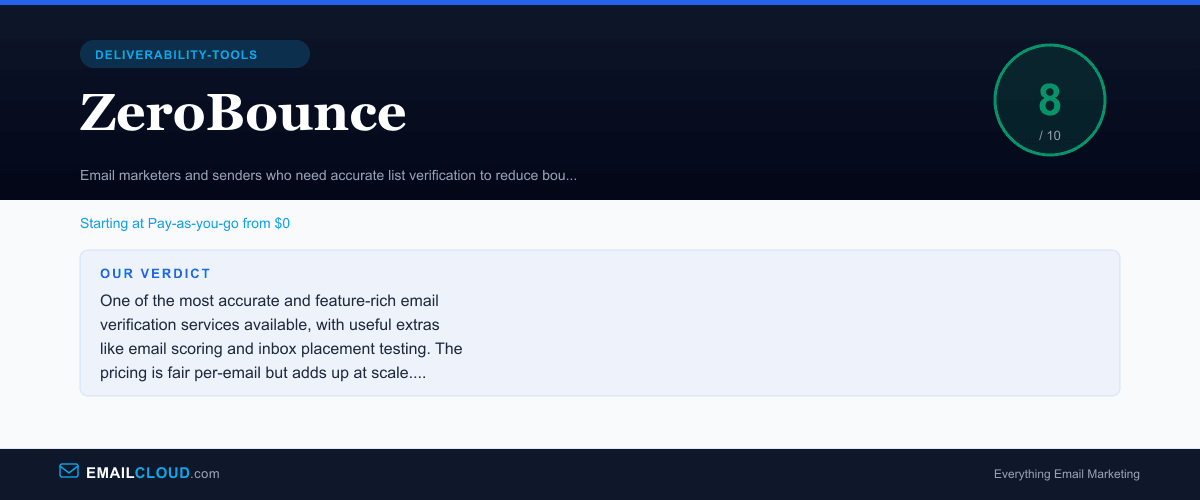
One of the most accurate and feature-rich email verification services available, with useful extras like email scoring and inbox placement testing. The pricing is fair per-email but adds up at scale. For senders with lists over 10,000 addresses, regular ZeroBounce cleaning is a deliverability best practice that pays for itself in reduced bounces and protected reputation.
Review Summary
Share this visual summary. Right-click to save.
Frequently Asked Questions
How accurate is ZeroBounce email verification?
ZeroBounce claims 98% or higher accuracy, and our testing largely confirmed this. When we ran a list of 10,000 known addresses through ZeroBounce, it correctly identified 97.3% of invalid addresses and produced very few false positives on known-good addresses. The main uncertainty is with catch-all domains, where the receiving server accepts all addresses regardless of whether the mailbox exists. No verification service can definitively validate catch-all addresses — ZeroBounce flags them as 'catch-all' so you can make your own risk decision.
Is ZeroBounce worth the cost?
It depends on your bounce rate and sending volume. If your list has a bounce rate above 2%, list cleaning will protect your sender reputation and improve deliverability — the cost of verification pays for itself by preventing IP blocks, domain reputation damage, and wasted sending costs. For a 100,000-address list at ZeroBounce's per-email rate, you would pay around $700. If cleaning that list prevents a deliverability crisis or improves inbox placement by even a few percentage points, the ROI is clear. For small lists under 5,000 addresses with low bounce rates, manual hygiene may be sufficient.
How does ZeroBounce compare to NeverBounce and BriteVerify?
All three are reputable email verification services with similar accuracy claims. ZeroBounce differentiates with its email scoring feature (predicting engagement likelihood) and its expanded toolkit including inbox placement testing and blacklist monitoring. NeverBounce tends to be slightly cheaper at high volumes. BriteVerify (now Validity BriteVerify) integrates tightly with the Validity ecosystem including Everest. Before committing to any paid verification service, run our free [Deliverability Tester](/delivery-check/) and [Blacklist Checker](/tools/blacklist-checker/) to assess whether list quality is actually your primary deliverability issue — you may find authentication or reputation problems that are easier to fix first. For pure verification accuracy, the differences between the major services are marginal — the choice often comes down to pricing at your volume and integration with your ESP.
Should I clean my email list before every send?
Not before every send, but regularly. We recommend verifying your full list every 90 days, plus validating new addresses at the point of capture using ZeroBounce's real-time API. Email addresses decay at roughly 2-3% per month as people change jobs, abandon mailboxes, or switch providers. Quarterly cleaning keeps your bounce rate low and your sender reputation healthy. If you send infrequently (less than monthly), clean the list before each send since more addresses will have gone stale between sends.
Stay ahead of the inbox
Weekly tips on deliverability, automation, and growing your list. No spam, ever.
No spam. Unsubscribe any time. We respect your inbox.