2025: 2025: The Newsletter Platform Wars Heat Up
The newsletter has been declared dead at least a dozen times since the mid-2000s. Killed by social media. Killed by RSS. Killed by Slack. Killed by push notifications. Yet here we are in 2025, and the newsletter is not only alive but at the center of a multi-billion-dollar platform war that is reshaping the email industry. The fight for newsletter dominance in 2025 is a story of explosive growth, strategic missteps, existential pivots, and the unmistakable signal that email remains the most valuable direct channel on the internet.
beehiiv: The Fastest Gun in the Game
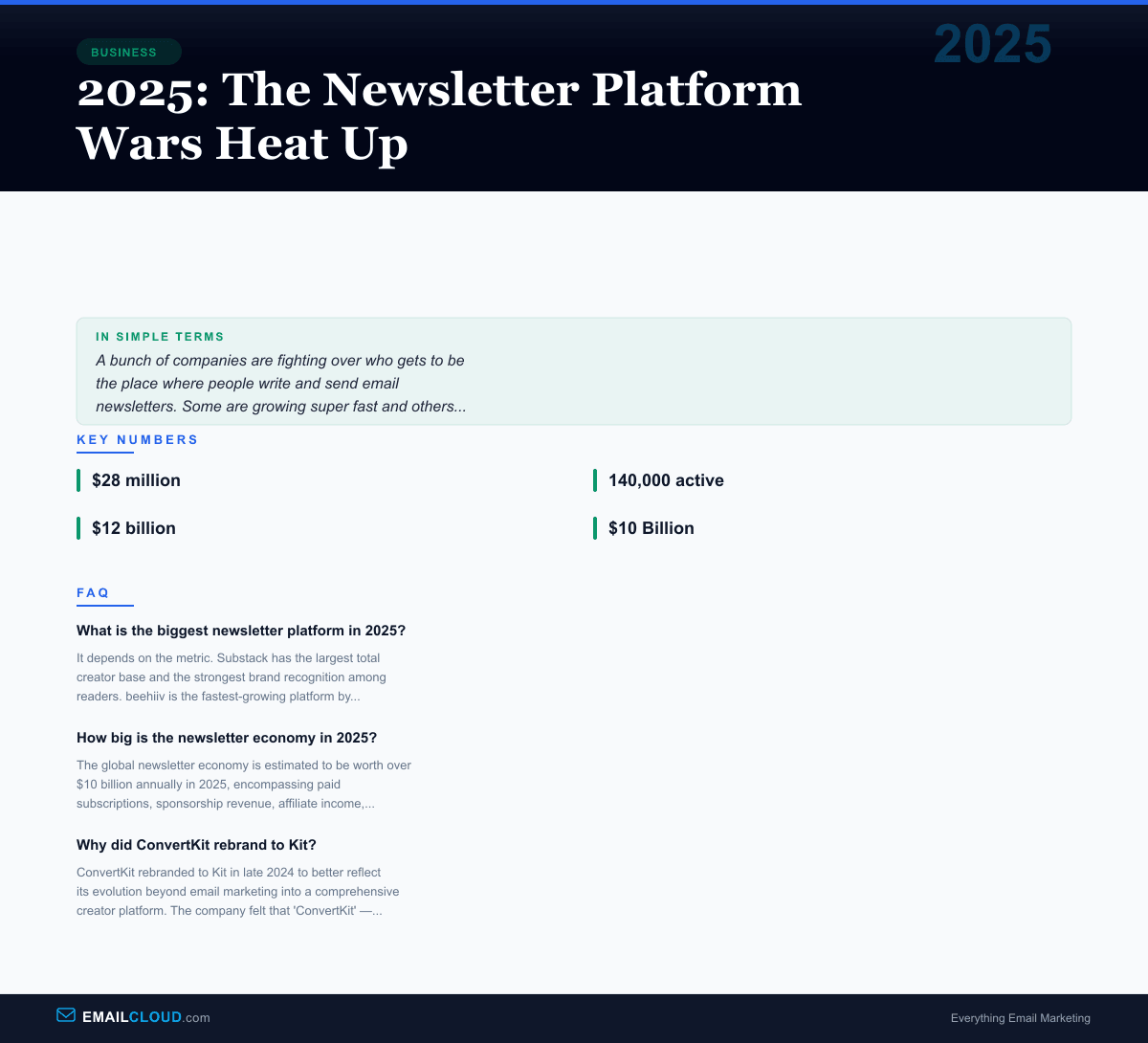
The most dramatic growth story of 2025 belongs to beehiiv. Founded in 2021 by former Morning Brew employees, beehiiv has positioned itself as the newsletter platform built by newsletter operators, for newsletter operators. The results speak for themselves: approximately $28 million in annual recurring revenue, more than 140,000 active newsletters on the platform, and a growth trajectory that has it doubling year over year.
beehiiv’s appeal is rooted in its growth-first philosophy. Where Substack optimized for the reading experience and writer brand, beehiiv optimized for the tools that make newsletters grow: referral programs, recommendation networks, A/B testing, audience segmentation, and a built-in advertising marketplace. For publishers who view their newsletter as a business rather than a creative outlet, beehiiv offers the operational toolkit that Substack lacks.
The platform’s ad network — which connects newsletter publishers with advertisers for native sponsorship placements — has been particularly effective. It solves the monetization problem that many newsletter operators struggle with: finding, negotiating, and managing sponsor relationships. beehiiv handles the advertising sales, matches sponsors with relevant newsletters, and handles the payments. The publisher just writes.
Substack: Growing but Controversial
Substack entered 2025 as the most recognized newsletter brand in the world. The platform pioneered the modern paid newsletter model and has created genuine celebrities — writers earning six and seven figures from email subscriptions alone. The Substack brand carries cultural weight: saying “I have a Substack” means something in a way that “I have a Mailchimp list” never did.
But 2025 also exposed Substack’s vulnerabilities. Content moderation controversies continued to generate negative press. Substack’s hands-off approach to editorial policy — allowing nearly any content that doesn’t violate narrowly defined terms of service — attracted criticism when extremist and conspiratorial content flourished on the platform. Some high-profile writers left, citing discomfort with sharing a platform with content they found objectionable.
Substack’s recommendation algorithm also drew scrutiny. The system, designed to help readers discover new writers, increasingly favored paid newsletters over free ones and established writers over newcomers. Critics argued that Substack was becoming the very kind of algorithmic gatekeeper that newsletters were supposed to be an escape from. The platform’s Notes feature — a social feed launched in 2023 — continued to evolve but struggled to find its identity between Twitter-like public discourse and newsletter-adjacent commentary.
Despite these challenges, Substack’s subscriber base continued to grow. The platform’s strength remains its reader experience: a clean, focused reading environment, a unified subscription management system, and a discovery mechanism that helps writers find audiences. For writers who want to build a paid subscriber base with minimal technical overhead, Substack remains the default choice.
Kit: The Rebrand Recovery
Kit — formerly ConvertKit — spent much of 2025 recovering from its late-2024 rebrand. The name change was a strategic bet: “ConvertKit” carried strong brand recognition among creators, but the company argued that the name was too narrow for a platform expanding into commerce, paid subscriptions, and comprehensive creator business management.
The rebrand was expensive in ways both obvious and subtle. SEO equity built over a decade under “ConvertKit” had to be rebuilt. Existing customers needed education about the change. Affiliate partners updated thousands of links and reviews. The creator economy press covered the rebrand extensively, but coverage skewed skeptical — “if it ain’t broke” was the prevailing sentiment.
Functionally, Kit continued to invest in its core strengths: powerful automation workflows, visual email builders, and audience segmentation tools that cater to professional creators. The platform’s commerce features — selling digital products, courses, and subscriptions directly through Kit — grew steadily. Kit occupies a unique position in the market: more powerful than Substack for creators who need marketing automation, more creator-focused than Mailchimp for those who want a complete business platform.
The recovery from the rebrand was slower than Kit’s leadership hoped. Brand recognition surveys showed “ConvertKit” still outperforming “Kit” in unaided recall among creators. But the platform’s retention rates remained strong — existing users weren’t leaving because of the name change, even if new user acquisition temporarily dipped.
Ghost: The Open-Source Contender
Ghost had a quietly excellent 2025. The open-source publishing platform, which can be self-hosted or used through Ghost’s managed hosting service, released major updates to its newsletter capabilities, membership management, and theme system. For publishers who want full ownership of their platform, data, and subscriber relationships — without vendor lock-in — Ghost is the clear choice.
Ghost’s growth was driven by the increasing sophistication of its target audience. As more newsletter operators matured from hobbyists into businesses, the desire for platform independence grew. Horror stories about Substack’s terms of service changes, Mailchimp’s account suspensions, and the general risk of building on someone else’s platform pushed technically capable publishers toward Ghost.
The platform’s challenge remains discoverability. Substack has a built-in recommendation engine. beehiiv has an ad network. Ghost newsletters exist on their own islands, relying on SEO, social media, and word of mouth for growth. For publishers with existing audiences, this independence is a feature. For new publishers trying to find their first thousand subscribers, it is a significant hurdle.
Mailchimp: The Fading Giant
If 2025’s newsletter platform war has a loser, it is Mailchimp.
Since Intuit’s $12 billion acquisition in 2021, Mailchimp has undergone the kind of corporate transformation that makes longtime users nervous. Product development slowed relative to competitors. The interface grew more complex as Intuit layered in cross-product features and upsells. Pricing changes pushed small creators toward cheaper alternatives. Layoffs at Intuit in 2024 and 2025 affected Mailchimp’s engineering and support teams.
The numbers tell the story. Mailchimp still has the largest total user base of any email marketing platform — years of market leadership created an enormous installed base. But net new creator signups shifted dramatically toward Substack, beehiiv, and Kit. In the newsletter economy specifically, Mailchimp went from dominant to marginal. The platform remains strong in traditional email marketing (ecommerce, small business campaigns, transactional email) but has largely lost the newsletter narrative.
The irony is significant. Mailchimp was, for over a decade, the default answer to “what platform should I use for my email newsletter.” The company’s own origin story is rooted in empowering small creators. Under Intuit, the platform increasingly feels like an enterprise tool wearing a friendly mascot costume.
The Social-to-Newsletter Pipeline
One of the defining developments of 2025 is the maturation of the social media-to-newsletter pipeline. The path from social media audience to email subscriber list became a standard growth strategy, with X/Twitter and LinkedIn as the primary feeders.
The pattern is now well-established. A creator builds an audience on social media through short-form content — tweets, LinkedIn posts, threads. Once they have traction, they launch a newsletter to convert followers into subscribers. The newsletter provides deeper content, exclusive insights, and a direct relationship that isn’t subject to algorithmic throttling. The social media profile becomes a funnel; the newsletter becomes the business.
This pipeline works because social media and newsletters serve complementary functions. Social media provides reach and discovery — it’s how new people find you. Email provides depth and monetization — it’s how you build relationships and generate revenue. The two channels are symbiotic rather than competitive, a dynamic that has contributed to the newsletter economy’s explosive growth.
LinkedIn, in particular, emerged as a powerful newsletter growth channel in 2025. The platform’s built-in newsletter feature (which automatically notifies all of a user’s LinkedIn connections about new issues) created a low-friction entry point for professional newsletters. While LinkedIn’s native newsletter tool is limited compared to dedicated platforms, it serves as an effective top-of-funnel mechanism for creators who then migrate their most engaged readers to Substack, beehiiv, or Kit.
The $10 Billion Question
The newsletter economy in 2025 is estimated to be worth over $10 billion annually when accounting for paid subscriptions, advertising and sponsorship revenue, affiliate income, and platform fees. This is a remarkable figure for what is, fundamentally, people writing things and emailing them to other people.
The business models have diversified beyond simple paid subscriptions. Advertising and sponsorship — sold directly or through platform-native ad networks like beehiiv’s — generate significant revenue for free newsletters with large audiences. Affiliate marketing produces income for niche newsletters with high-intent readerships. Premium content tiers, community access, and digital product sales create additional revenue streams.

What the platform war of 2025 really demonstrates is that email’s value as a direct channel has never been higher. Every platform in this fight — Substack, beehiiv, Kit, Ghost, and even the struggling Mailchimp — is ultimately betting on the same thesis: that a direct email relationship between a creator and their audience is the most valuable asset in digital media. They’re arguing about features, pricing, and philosophy. They all agree on the fundamental point.
Email wins. Again. The only question is who gets to host the winning.
Infographic
Share this visual summary. Right-click to save.
Related Events
Frequently Asked Questions
What is the biggest newsletter platform in 2025?
It depends on the metric. Substack has the largest total creator base and the strongest brand recognition among readers. beehiiv is the fastest-growing platform by revenue, reaching approximately $28M ARR and over 140,000 active newsletters in 2025. Kit (formerly ConvertKit) has the deepest creator tooling. Ghost leads the open-source newsletter space. Mailchimp remains the largest by total user base but is losing market share among creators.
How big is the newsletter economy in 2025?
The global newsletter economy is estimated to be worth over $10 billion annually in 2025, encompassing paid subscriptions, sponsorship revenue, affiliate income, and related services. This includes platform revenue, creator income, advertising spend within newsletters, and the tools and services that support the newsletter ecosystem. Paid newsletters alone generate hundreds of millions in subscription revenue across platforms.
Why did ConvertKit rebrand to Kit?
ConvertKit rebranded to Kit in late 2024 to better reflect its evolution beyond email marketing into a comprehensive creator platform. The company felt that 'ConvertKit' — with its emphasis on conversion — was too narrow for a platform that now offered newsletters, paid subscriptions, commerce tools, and audience management. The rebrand was controversial among long-time users and required significant marketing investment to rebuild brand recognition.
Stay ahead of the inbox
Weekly tips on deliverability, automation, and growing your list. No spam, ever.
No spam. Unsubscribe any time. We respect your inbox.