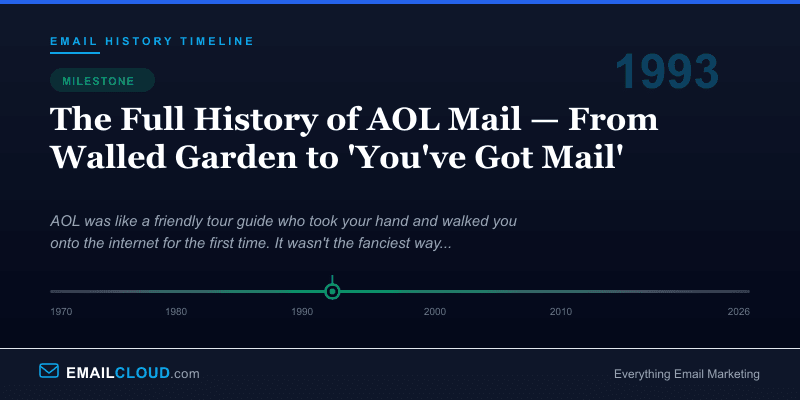
1993: The Full History of AOL Mail — From Walled Garden to 'You've Got Mail'
No company in the history of the internet brought more people online than America Online. At its peak, AOL was the internet for roughly half of all connected Americans — not an internet service provider in the modern sense, but a complete, self-contained digital universe with its own email, chat rooms, news, shopping, and content. AOL’s email service was the gateway drug. For tens of millions of people, @aol.com was their first email address, their first digital identity, and their first taste of what networked communication could feel like. This is the full story of how AOL built it, dominated it, nearly destroyed it, and somehow never fully killed it.
The Early Days: Quantum to AOL (1985-1991)
AOL’s origins trace back to 1985, when a small Virginia company called Quantum Computer Services launched an online service for Commodore 64 computers called Q-Link. The service offered games, news, file downloads, and electronic messaging — all delivered over dial-up modem connections at 300 to 2400 baud. Q-Link’s messaging was primitive by modern standards, but it established the fundamental concept: log in, check for messages, send messages to other members, log off.
Quantum expanded to other platforms (PC-Link for IBM compatibles, AppleLink for Macintosh users) and in 1991 rebranded itself as America Online. The new name was aspirational and geographic — this was going to be the online service for all of America. Under CEO Steve Case, AOL began an aggressive growth campaign that would define the company for the next decade.
The Disc Carpet Bombing (1993-2001)
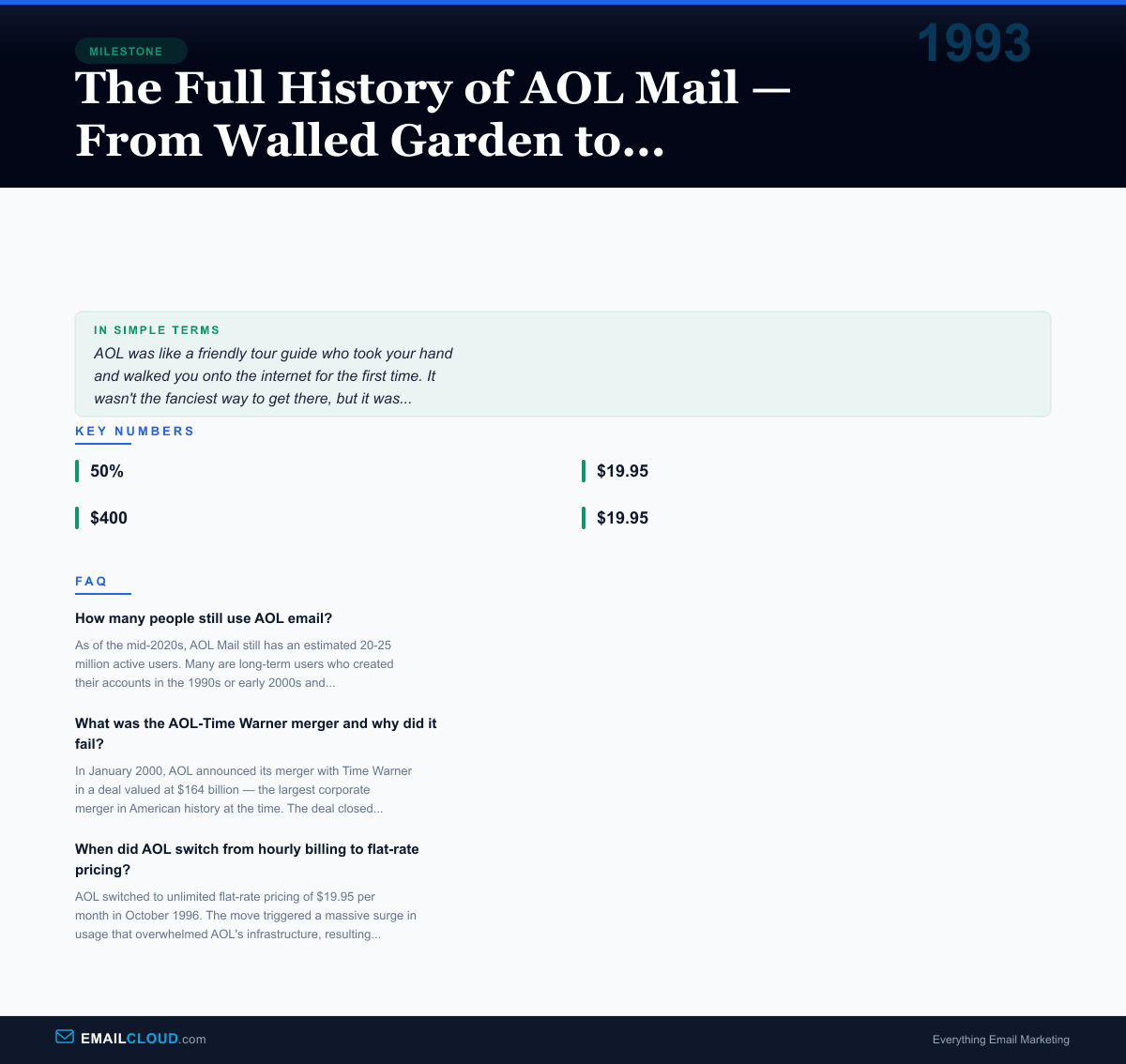
AOL’s growth strategy was brutally simple: put a free trial disc in front of every American who could fog a mirror. The company mailed CD-ROMs inside magazines, newspapers, and direct mail envelopes. Discs were bundled with electronics purchases, distributed at grocery store checkout counters, stuffed inside cereal boxes, and handed out at conferences. By some estimates, AOL produced and distributed over 1 billion free trial CDs during the 1990s. At one point, roughly 50% of all CDs manufactured in the world were reportedly AOL trial discs.
The installation process was designed for absolute beginners. Pop in the disc, follow the wizard, choose a screen name, plug your phone line into the modem, and you were online. AOL handled everything — modem configuration, dial-up connection, email setup — behind a friendly graphical interface. No POP3 server addresses, no SMTP settings, no DNS configuration. Just point and click.
Opening the Gates (1993)
The most consequential moment in AOL’s email history came in 1993, when the service opened its email gateway to the broader internet. Before this, AOL was a walled garden. AOL users could email other AOL users, but they couldn’t reach — or be reached by — anyone using standard internet email. The service was an island.
Opening the gateway changed everything. Suddenly, a grandmother in Ohio with an @aol.com address could email her grandson at his university @edu address. A small business owner could receive email from anyone on the internet, not just fellow AOL subscribers. AOL users were part of the global email ecosystem.
This was also the moment that transformed email from a niche technology into a mass communication medium. AOL’s user base — already millions strong — was suddenly participating in the same email network as corporate workers, university researchers, and government employees. The volume of email flowing across the internet increased dramatically.
The $19.95 Disaster (1996)
Through the mid-1990s, AOL charged by the hour. Users paid a base monthly fee for a limited number of hours, then steep overage charges for additional time. This pricing model worked for AOL’s business but created anxiety for users, who watched the clock while they were online and rushed through their email to avoid charges. Horror stories circulated about parents receiving $400 bills because their teenager spent too much time in chat rooms.
In October 1996, AOL made a bet-the-company decision: unlimited access for a flat rate of $19.95 per month. The response was overwhelming — and catastrophic. Usage immediately spiked as users who had been rationing their online time suddenly had no reason to log off. AOL’s infrastructure couldn’t handle the load. Millions of users got nothing but busy signals when they tried to connect.
The outrage was immediate and widespread. Users couldn’t reach the service they were paying for. The media dubbed it “America On Hold.” Multiple state attorneys general launched investigations, arguing that AOL was advertising a service it couldn’t deliver. AOL eventually settled the complaints and invested heavily in infrastructure expansion, but the episode revealed the tension between growth and capacity that would haunt the company for years.
”You’ve Got Mail” — The Cultural Moment
The three words that defined AOL’s brand came from an unlikely source. In 1989, a broadcaster named Elwood Edwards recorded “Welcome,” “You’ve got mail,” “File’s done,” and “Goodbye” on a cassette tape in his living room. His wife, Karen Edwards, worked at Quantum Computer Services and had mentioned that the company needed voice prompts for its online service.
Edwards recorded the phrases in a single take. They became, arguably, the most recognized sound bites of the decade. “You’ve got mail” transcended its function as a notification — it became a cultural touchstone representing the excitement of digital connection. The phrase was so embedded in American culture that it became the title of a 1998 romantic comedy starring Tom Hanks and Meg Ryan, in which the two leads fall in love through anonymous AOL email correspondence.
The AOL Keywords Era
AOL’s walled-garden approach meant that the company created its own simplified navigation system: AOL Keywords. Instead of typing URLs, users could type keyword shortcuts — “AOL Keyword: SHOPPING” or “AOL Keyword: NEWS” — to navigate to sections within AOL’s ecosystem. Television commercials, magazine ads, and product packaging featured AOL Keywords alongside (or instead of) website URLs.
This system extended to email in subtle ways. AOL users experienced the internet primarily through AOL’s curated lens, and email was integrated into that ecosystem. The email interface included links to AOL content, AOL chat rooms, and AOL services. For many users, the boundary between “AOL” and “the internet” was blurry at best.
The Time Warner Merger Disaster (2000-2009)
In January 2000, AOL announced the most audacious corporate merger in history: AOL would acquire Time Warner — the media conglomerate that owned CNN, HBO, Warner Bros., Time magazine, and dozens of other properties — in a deal valued at approximately $164 billion. It was the largest merger ever proposed, and it was structured so that AOL, the internet upstart, was technically acquiring Time Warner, the media establishment.
The deal closed in January 2001. It failed almost immediately. AOL’s valuation had been based on dot-com era stock prices that were already collapsing. Broadband internet was making dial-up obsolete, destroying AOL’s core subscription business. The corporate cultures clashed viciously — Time Warner’s old-media executives resented being “acquired” by what they saw as an overvalued internet company, and AOL’s internet-era managers couldn’t navigate Time Warner’s entrenched bureaucracy.
By 2002, the merged company had written down $99 billion in losses. The AOL-Time Warner merger is routinely cited as the worst corporate merger in business history. In 2003, the company dropped “AOL” from its name, reverting to simply “Time Warner.” AOL was spun off as an independent company in 2009.
Slow Decline, Stubborn Survival
After the Time Warner debacle, AOL’s subscriber base fell steadily. From a peak of roughly 30 million subscribers in 2002, the number dropped to 6.9 million by 2009 and continued to decline. The company pivoted to advertising and content (acquiring The Huffington Post and TechCrunch), but the dial-up business that had built AOL was clearly dying.
Verizon acquired AOL in 2015 for $4.4 billion. In 2017, Verizon combined AOL with Yahoo to form a subsidiary called Oath (later renamed Verizon Media). In 2021, Verizon sold the entire unit to Apollo Global Management for $5 billion. Through all of this corporate shuffling, AOL Mail kept running.
And people kept using it. In the mid-2020s, AOL Mail still has an estimated 20 to 25 million active users. Many are older adults who created their accounts in the 1990s and see no reason to switch. Their email works. Their contacts have the address. The fact that @aol.com now carries a faint stigma — signaling to some that you’re not technically current — doesn’t bother them in the least.
Why AOL Still Matters
AOL’s legacy in email is not about technology. The company didn’t invent email, didn’t build the best email client, and didn’t offer the most storage or the most features. What AOL did was prove, at massive scale, that ordinary people wanted to use email and would use it enthusiastically if someone made it easy enough.
That insight shaped every email service that followed. Hotmail and Gmail both inherited AOL’s core philosophy: email should be accessible to everyone, not just the technically literate. The entire email marketing industry exists because AOL turned email from a specialist tool into a universal communication channel.
For marketers reaching the AOL audience today, simplicity still wins. Clean designs, clear subject lines, and straightforward copy perform best. Run your next campaign’s subject lines through our Subject Line Grader to make sure they’re compelling enough to earn an open in an inbox that’s been filtering messages since the 1990s.
Infographic
Share this visual summary. Right-click to save.
Related Events
Frequently Asked Questions
How many people still use AOL email?
As of the mid-2020s, AOL Mail still has an estimated 20-25 million active users. Many are long-term users who created their accounts in the 1990s or early 2000s and never migrated. AOL Mail is now owned by Yahoo (via Apollo Global Management's 2021 acquisition of Verizon Media), and the service continues to operate with no announced shutdown date.
What was the AOL-Time Warner merger and why did it fail?
In January 2000, AOL announced its merger with Time Warner in a deal valued at $164 billion — the largest corporate merger in American history at the time. The deal closed in 2001. It failed catastrophically because AOL's valuation was based on dot-com bubble economics, broadband replaced dial-up (destroying AOL's core business), and the two corporate cultures were fundamentally incompatible. By 2002, the merged company had written down $99 billion in losses. It's widely considered the worst merger in business history.
When did AOL switch from hourly billing to flat-rate pricing?
AOL switched to unlimited flat-rate pricing of $19.95 per month in October 1996. The move triggered a massive surge in usage that overwhelmed AOL's infrastructure, resulting in constant busy signals and the inability to connect. Users dubbed the service 'America On Hold,' and multiple state attorneys general investigated the company for advertising unlimited access it couldn't deliver.
Stay ahead of the inbox
Weekly tips on deliverability, automation, and growing your list. No spam, ever.
No spam. Unsubscribe any time. We respect your inbox.