1989: CompuServe and Prodigy — The Pre-Internet Email Pioneers
Before the internet was the internet — before web browsers, before URLs, before Google — there were online services. Proprietary networks that you dialed into with a modem, navigated with text commands or rudimentary graphics, and paid for by the minute. Two of the most important were CompuServe and Prodigy, and together they introduced millions of Americans to the concept of electronic messaging years before “email” became a household word. Their story is the forgotten prologue to the email revolution.
CompuServe: Where Your Address Was a Number
CompuServe’s origins predate the personal computer. The company started in 1969 as a timesharing service in Columbus, Ohio — a business that sold processing time on mainframe computers to other businesses. In 1979, CompuServe launched MicroNET, a consumer-oriented service that offered computer hobbyists access to databases, forums, and messaging over dial-up connections. MicroNET was later renamed the CompuServe Information Service, and it became the first major commercial online service aimed at ordinary consumers.
By the early 1980s, CompuServe offered electronic mail — but it looked nothing like what we’d recognize as email today. Your CompuServe address was a numeric user ID in the format 72241,132. That comma was part of the address. There were no usernames, no @gmail.com, no human-readable handles. You were a number in a mainframe database, and if you wanted to send a message to another CompuServe user, you needed to know their number.
Composing a message on CompuServe in 1983 meant navigating a text-based menu system over a modem connection running at 300 baud — roughly 30 characters per second. You’d select the email option, type the recipient’s numeric ID, compose your message in a basic text editor, and send it. The entire process might take 10 minutes, all of it billed at CompuServe’s hourly rate, which ranged from $6 to $12.50 per hour depending on the time of day and connection speed. At those prices, brevity wasn’t just a stylistic choice — it was financial self-defense.
The CompuServe Community
Despite the clunky interface and eye-watering costs, CompuServe built a remarkably active community. The service’s forums — organized by topic and managed by volunteer system operators (“sysops”) — were among the most vibrant online discussion spaces of the 1980s. Technology enthusiasts, hobbyists, journalists, and early adopters gathered on CompuServe to discuss everything from programming to photography to politics.
Email was the connective tissue of this community. Forum discussions generated follow-up conversations via private messages. Business relationships formed in CompuServe forums were maintained through CompuServe email. For many of these early users, CompuServe email was their first experience with asynchronous digital communication — the revelation that you could send someone a message and they would read it hours or days later, at their convenience, and respond in kind.
CompuServe peaked at approximately 3 million subscribers in the mid-1990s. The service was especially popular among business professionals, who valued its premium databases, stock quotes, and the relative sophistication of its user base compared to newer services like AOL.
The Internet Gateway
CompuServe’s most significant contribution to email history came in 1989, when the service opened a gateway to internet email. For the first time, CompuServe’s subscribers could send messages to — and receive messages from — anyone with a standard internet email address.
The gateway created a peculiar addressing challenge. CompuServe’s internal addresses used a comma (72241,132), but internet email addresses can’t contain commas. The solution was simple: replace the comma with a period for internet-facing addresses. Your CompuServe email address to the outside world became 72241.132@compuserve.com. It was ugly, impossible to remember, and utterly unguessable — but it worked.
This gateway was an early example of a pattern that would repeat throughout the 1990s: walled gardens reluctantly connecting to the open internet as users demanded interoperability. CompuServe, AOL, and Prodigy all eventually opened internet email gateways, and each time they did, their proprietary messaging systems became a little less proprietary and a little more like standard email.
Prodigy: The Graphical Pioneer
Prodigy approached online services from a different angle entirely. Launched in 1988 as a joint venture between two corporate giants — Sears, Roebuck and Co. and IBM — Prodigy was designed from the start as a mass-market consumer product. Where CompuServe was text-based and aimed at technically literate users, Prodigy featured colorful graphical screens, point-and-click navigation, and a layout that resembled a digital magazine more than a computer terminal.
Prodigy’s interface was revolutionary for its time. Each screen was a combination of content and advertising, rendered in a proprietary format that the Prodigy client software displayed on the user’s computer. Navigation was done through on-screen buttons and menus rather than typed commands. For consumers who found CompuServe’s text menus intimidating, Prodigy was approachable and visually engaging.
The service included email messaging, though Prodigy’s implementation was more limited than CompuServe’s. Prodigy users could send messages to other Prodigy users, and the messages were displayed within the Prodigy interface rather than in a separate email client. The experience was closer to an internal messaging system than to what we’d now call email.
Prodigy’s internet email gateway came later than CompuServe’s, and the service struggled to keep pace with the rapidly evolving internet landscape of the mid-1990s. At its peak, Prodigy had approximately 2 million subscribers. Sears and IBM sold the service in 1996, and after passing through several owners, Prodigy shut down in 1999. The brand was later revived as an internet service provider but never regained its former significance.
GEnie: The Forgotten Third
General Electric’s GEnie (GE Network for Information Exchange) deserves a mention as the third major pre-internet online service. Launched in 1985, GEnie offered many of the same features as CompuServe — email, forums, databases, games — at significantly lower prices. GEnie’s aggressive pricing (particularly during off-peak hours) made it popular among hobbyists and gamers.
GEnie’s email system functioned similarly to CompuServe’s: users had assigned addresses, could send messages to other GEnie subscribers, and eventually gained internet email gateway access. GEnie never achieved CompuServe’s scale or Prodigy’s consumer appeal, but it played an important role in introducing middle-market users to electronic messaging. GE shut down GEnie in 1999.
The Business Model That Couldn’t Last
All three services shared a fundamental business model problem: they charged by the minute. CompuServe’s rates could run $12.50 per hour at peak times. Prodigy charged a monthly base fee but limited usage. GEnie’s pricing varied by time of day. In all cases, the meter was always running, and users were acutely aware that every minute spent reading or composing email was costing them money.
This per-minute model shaped email behavior in ways that seem almost alien today. Messages were composed offline in text editors, then uploaded as quickly as possible to minimize connection time. Replies were terse. Attachments were avoided because they increased transmission time. The leisurely inbox browsing that we take for granted was, in the CompuServe era, an expensive luxury.
The model also limited adoption. As long as email cost money to send and receive, it remained the province of professionals, hobbyists, and early adopters. The mass adoption of email required a different economic model — one where the service was free to the user and supported by advertising or bundled with ISP subscriptions. Hotmail, Juno, and eventually Gmail each took steps toward that model, and each drew directly on the consumer demand that CompuServe, Prodigy, and GEnie had helped create.
Why They Matter
CompuServe and Prodigy trained millions of people to expect electronic messaging as a basic feature of being online. Before these services, email was an academic and government tool — something that existed on ARPANET and university networks but had no presence in ordinary people’s lives. CompuServe and Prodigy made email a consumer product. They proved there was mass-market demand for the ability to send and receive electronic messages, even at premium prices over slow connections.
They also established patterns that persist in email to this day. The concept of an email address as a personal identifier. The inbox as a list of messages to be reviewed and acted upon. The distinction between read and unread messages. The address book. Even the basic flow — compose, address, send, wait for reply — was refined in these early services before the internet standardized it.
The companies themselves are gone. CompuServe was absorbed into AOL in 1998 (its forums were shut down in 2009), Prodigy closed in 1999, and GEnie disappeared the same year. But every time you open your inbox, you’re using a tool whose consumer form was shaped by these pre-internet pioneers. The tools have changed; the core experience they invented has not.
Infographic
Share this visual summary. Right-click to save.
Related Events
Frequently Asked Questions
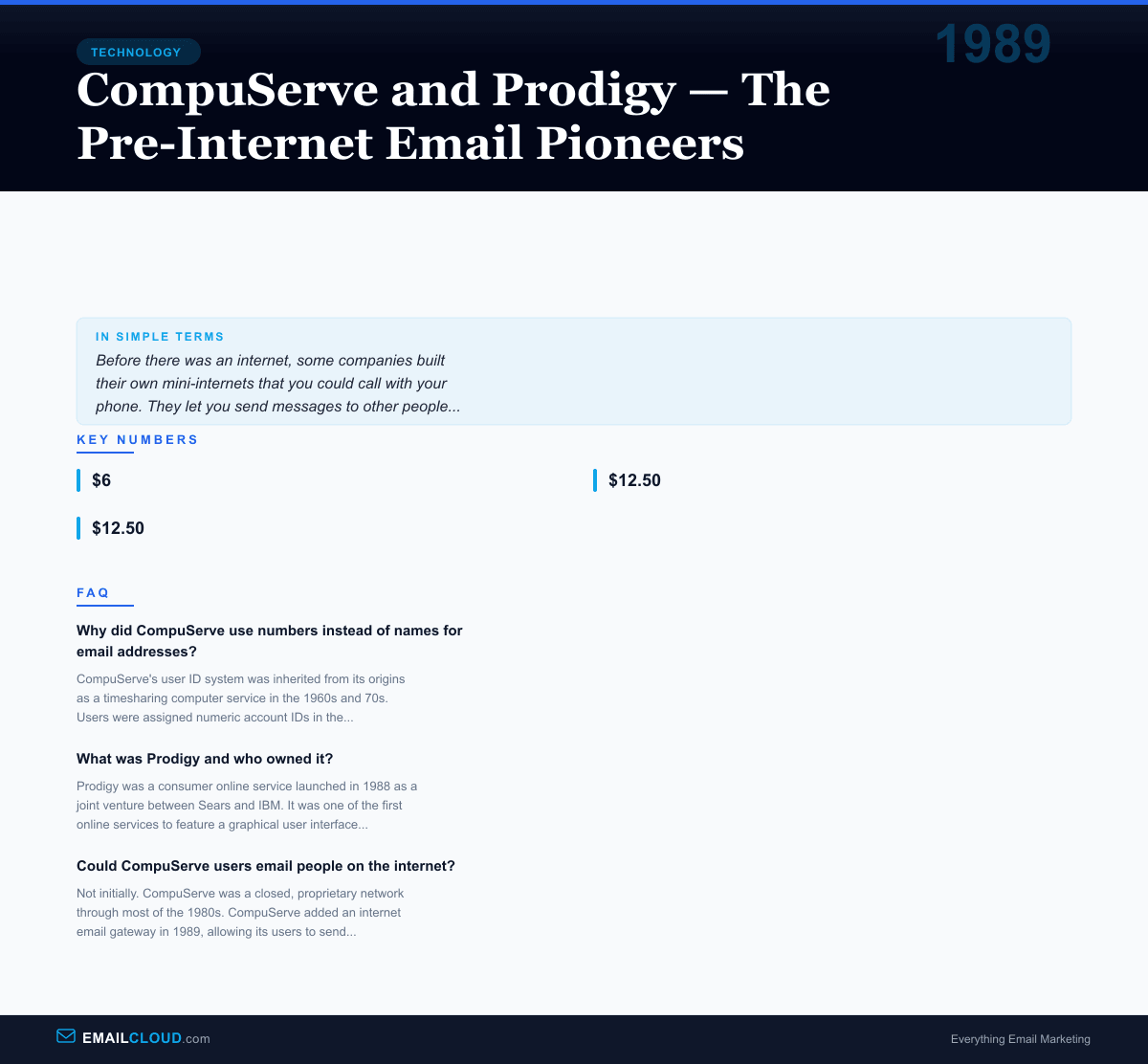
Why did CompuServe use numbers instead of names for email addresses?
CompuServe's user ID system was inherited from its origins as a timesharing computer service in the 1960s and 70s. Users were assigned numeric account IDs in the format NNNNN,NNNN (e.g., 72241,132) because the system was originally designed for mainframe user management, not consumer-friendly communication. When email was added, these existing account numbers became email addresses. The comma was later replaced with a period for internet compatibility (72241.132@compuserve.com).
What was Prodigy and who owned it?
Prodigy was a consumer online service launched in 1988 as a joint venture between Sears and IBM. It was one of the first online services to feature a graphical user interface with colorful screens, advertisements, and point-and-click navigation. Prodigy offered email, bulletin boards, news, shopping, and games. At its peak in the early 1990s, it had approximately 2 million subscribers. Sears and IBM sold the service in 1996, and it went through several owners before shutting down in 1999.
Could CompuServe users email people on the internet?
Not initially. CompuServe was a closed, proprietary network through most of the 1980s. CompuServe added an internet email gateway in 1989, allowing its users to send and receive email from internet users. To receive internet email, CompuServe users gave out addresses in the format 72241.132@compuserve.com (with the comma replaced by a period, since commas aren't valid in email addresses).
Stay ahead of the inbox
Weekly tips on deliverability, automation, and growing your list. No spam, ever.
No spam. Unsubscribe any time. We respect your inbox.