2000: How Email Transformed the Workplace — For Better and Worse
Somewhere around the year 2000, a threshold was crossed in offices around the world. Email stopped being a tool you used alongside your work and became the work itself. The transition was gradual — a slow accumulation of CC’d threads, forwarded requests, and “just wanted to follow up” messages that eventually reached a critical mass. One day, the average knowledge worker sat down at their desk, opened their inbox, and realized they would spend the majority of their working hours reading, writing, sorting, and responding to email. The memo was dead. The fax was dying. And the tool that replaced them was consuming the workday it was supposed to streamline.
The Death of the Memo
The inter-office memo had ruled business communication for most of the twentieth century. Typed on letterhead, routed through internal mail, filed in manila folders — the memo was slow, formal, and hierarchical. Writing one required thought, because distributing it required effort. You didn’t dash off a memo on impulse. You drafted it, possibly ran it past your supervisor, printed it, made copies, and physically distributed them to the relevant parties. The friction was a feature: it meant that only communication important enough to justify the effort made it into the system.
Email eliminated that friction entirely. A message that would have taken an hour to draft, approve, photocopy, and distribute could be composed and sent in two minutes. The immediate result was faster communication. The secondary result was more communication — vastly more. When the cost of sending a message drops to zero, the volume of messages explodes. The memo was a dam. Email removed the dam, and communication flooded the office.
The fax machine died a slower death but for the same reason. Fax required a dedicated phone line, a physical document, and the recipient’s fax number. Email could transmit the same document as an attachment, to multiple recipients simultaneously, with a cover note that replaced the fax cover sheet. By the mid-2000s, the fax machine was a relic in most offices — kept in a corner for the rare occasion when a government form or medical office still required one.
The Flattening of Hierarchies
In the memo era, communication followed the organizational chart. You wrote to your immediate supervisor, who decided whether to escalate to their supervisor. Information traveled up the chain, decisions traveled down. Skipping levels was a political act — going over your boss’s head was career-threatening in most organizations.
Email dissolved these barriers almost accidentally. The technology didn’t know or care about org charts. Any employee could compose a message to any other employee, including the CEO, as long as they had the email address. And corporate directories made email addresses universally available. The junior analyst who would never have written a memo to the VP of Marketing could now send an email with a question, an idea, or a concern — and the VP might actually read it, because it appeared in the same inbox as everything else.
The CC field amplified this flattening. Copying someone on an email was trivially easy, and it became standard practice to CC managers, stakeholders, and anyone who might conceivably need to know about a conversation. This created transparency — everyone could see what was being discussed — but also created the phenomenon of “CC culture,” where people copied everyone on everything as a form of organizational self-protection. If something went wrong, you could point to the email chain and say, “I CC’d you on this three weeks ago.”
The Rise of CC Culture
CC culture deserves its own examination because it represents one of email’s most insidious workplace effects. The CC field was designed for informational copies — keeping relevant parties in the loop without requiring them to act. In practice, it became a tool for accountability theater, political maneuvering, and organizational anxiety.
“CC’ing your boss” became shorthand for escalation without confrontation. If a colleague wasn’t responding to your requests, CC’ing their manager was a passive-aggressive power move that applied social pressure without the discomfort of a direct conversation. “CC’ing everyone” became a way of distributing responsibility — if twenty people were copied on a decision, no single person could be blamed if it went wrong.
The result was an explosion of email volume directed at people who didn’t need to read it. Studies have found that a significant portion of the emails knowledge workers receive are CC’d messages that require no action and contain no information relevant to the recipient. But the social cost of removing yourself from a CC chain — “why wasn’t I included?” — meant that most people endured the volume rather than asking to be dropped.
Email Enabled Remote Work
The connection between email and remote work is underappreciated. Long before Zoom and Slack, email made location-independent work possible. If your job consisted primarily of reading documents, making decisions, and communicating those decisions to others — and by the late 1990s, many white-collar jobs fit this description — email removed the requirement to be physically present in an office.
The early telecommuters of the late 1990s and 2000s relied almost entirely on email. They received assignments by email, asked questions by email, submitted work by email, and received feedback by email. The workflow was asynchronous by nature — you sent a message, waited for a reply, and worked on something else in the interim. This asynchronous model worked well for tasks that didn’t require real-time collaboration, and it allowed people to work from home, from coffee shops, from other cities, or from other countries.
When the COVID-19 pandemic forced millions of workers home in March 2020, the sudden shift was enabled by decades of email infrastructure that had already made remote communication routine. Video conferencing was the visible symbol of pandemic-era remote work, but email was the invisible foundation that had been making distributed work possible for 20 years.
The BlackBerry Era: Email Becomes Inescapable
The introduction of mobile email — particularly through the BlackBerry — transformed workplace email from something you did at your desk to something you did everywhere, all the time. The BlackBerry’s push email technology delivered messages to the device instantly, and the blinking red notification LED created a Pavlovian response that made checking email compulsive.
The “CrackBerry” era, roughly 2003 to 2010, established the always-on work culture that persists today. Executives checked email at dinner, on vacation, and at their children’s school events. The expectation of rapid response — previously limited to business hours — expanded to evenings, weekends, and holidays. The implicit message was clear: if you have a device that can receive email, you’re expected to be available.
This cultural shift happened without any explicit policy change in most organizations. No CEO announced that employees were now required to answer email at 10 PM on a Saturday. But the technology created the capability, social norms filled the gap, and within a few years, responding to evening email was simply expected in many professional environments. The erosion of work-life boundaries, which researchers have linked to increased stress, burnout, and decreased job satisfaction, was a gradual process enabled by technology and cemented by culture.
The Reply All Problem
No discussion of workplace email is complete without acknowledging the Reply All catastrophe — a phenomenon unique to email and one of its most dreaded failure modes. When someone accidentally sends a message to a large distribution list and recipients begin replying to all, the resulting email storm can generate millions of messages, crash servers, and consume the collective attention of an entire organization for hours.
But even outside of catastrophic storms, the Reply All button is a daily source of workplace friction. Meetings are scheduled, rescheduled, and debated in Reply All threads that fill the inboxes of people who don’t need to be involved. Conversations between two people play out in front of twenty witnesses. The Reply All button is the workplace equivalent of having every conversation at full volume in an open-plan office — everyone can hear everything, whether they want to or not.
The Productivity Paradox
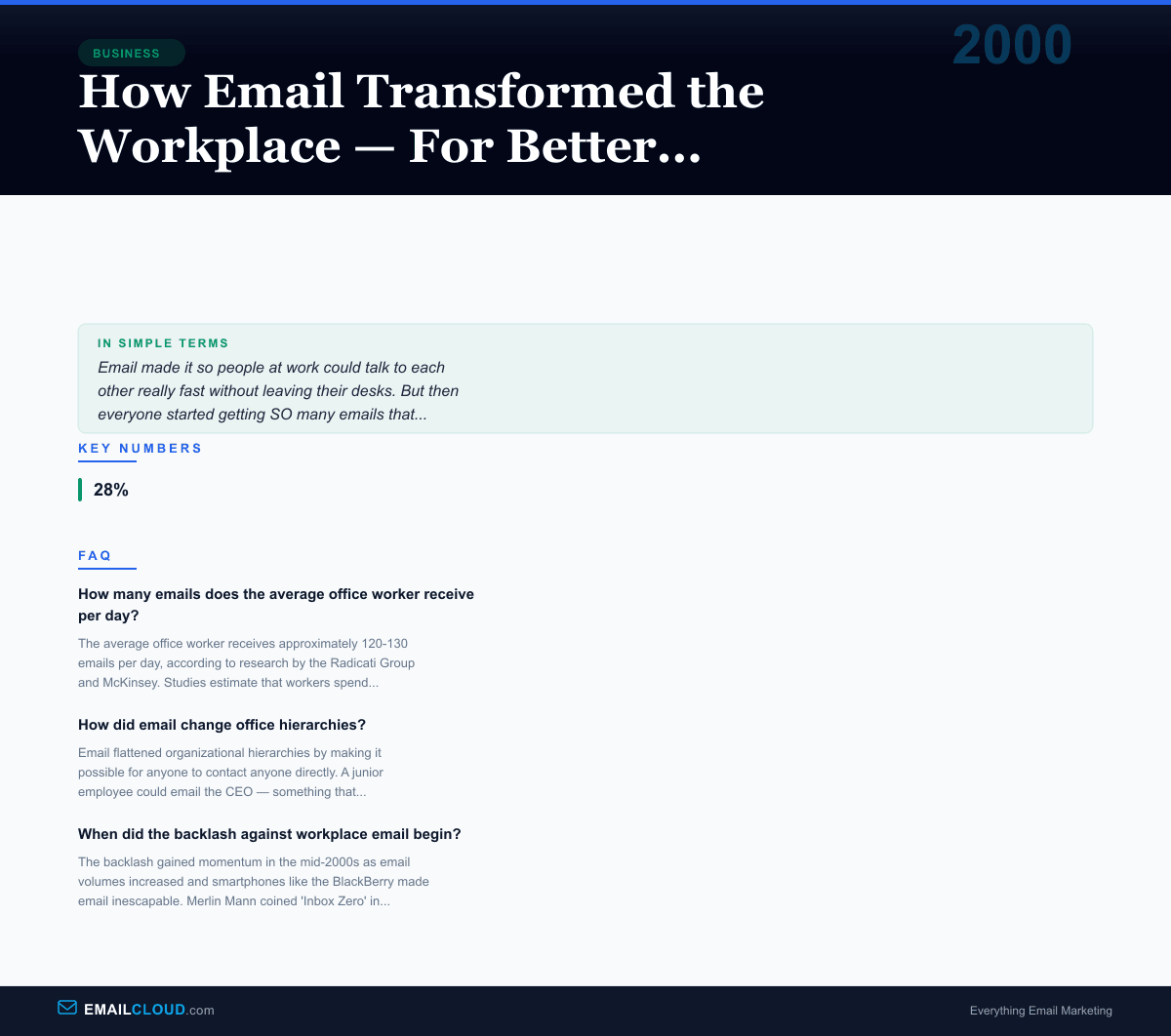
The central irony of workplace email is quantifiable. Studies by McKinsey, the Radicati Group, and numerous academic researchers consistently find that knowledge workers spend approximately 28% of their workday on email — about 2.5 hours per day. The average office worker receives 120-130 emails daily. Managers and executives receive significantly more.
A tool designed to make communication faster and more efficient has become the single largest consumer of productive time in the modern office. The paradox isn’t that email is inefficient — individual messages are extremely efficient compared to the memos, phone calls, and meetings they replaced. The paradox is that email’s efficiency generated so much communication that the total time spent communicating increased dramatically.
This is the fundamental tension that email never resolved: reducing the cost of sending a message doesn’t reduce the cost of receiving one. Each email takes time to read, evaluate, and decide upon, even if the decision is simply to archive it. When the volume of incoming messages exceeds a person’s capacity to process them, email stops being a productivity tool and becomes a productivity burden.
The Backlash
The backlash arrived in stages. In 2006, Merlin Mann introduced the concept of Inbox Zero — not an empty inbox as a goal, but a disciplined approach to processing email efficiently. The idea resonated because the problem it addressed was universal: the overwhelming, never-ending, always-growing email inbox.
Companies began experimenting with structural interventions. Some instituted “email-free Fridays,” encouraging employees to walk to each other’s desks instead of sending messages. Some limited internal email distribution lists. Some adopted tools like Basecamp, which centralized project communication in threads rather than email chains.
The most significant intervention was the emergence of workplace chat tools — Slack (2013), Microsoft Teams (2017), and their competitors. These tools explicitly positioned themselves as alternatives to internal email, offering real-time messaging, channels organized by topic, and integrations with other workplace tools. The pitch was compelling: use chat for quick internal communication and reserve email for external contacts and formal correspondence.
The irony, of course, is that workplace chat tools introduced their own set of problems — constant notifications, pressure to respond immediately, and yet another channel demanding attention. The fundamental issue was never email specifically. It was the volume of digital communication that modern work generates. Email was the first tool to make that volume possible. It won’t be the last.
The Paradox That Persists
Despite every prediction, every “email killer,” and every piece of workplace productivity software designed to reduce email volume, email remains dominant. Over 300 billion emails are sent daily. The average knowledge worker’s inbox is fuller than ever. Email has outlasted every challenger because it does something no other tool replicates: it provides a universal, asynchronous, documented communication channel that works across every organization, platform, and device.
The workplace of 2026 runs on email just as the workplace of 2000 did. The tools around it have changed — chat, video, project management software — but email remains the connective tissue. It’s the channel where contracts are sent, where clients communicate, where official records live, and where the CC chain ensures that nobody can say they weren’t informed. Email transformed the workplace profoundly, created problems it cannot solve, and remains, despite everything, indispensable.
Infographic
Share this visual summary. Right-click to save.
Related Events
Frequently Asked Questions
How many emails does the average office worker receive per day?
The average office worker receives approximately 120-130 emails per day, according to research by the Radicati Group and McKinsey. Studies estimate that workers spend roughly 28% of their workday — about 2.5 hours — reading, writing, and managing email. For managers and executives, the volume is often significantly higher.
How did email change office hierarchies?
Email flattened organizational hierarchies by making it possible for anyone to contact anyone directly. A junior employee could email the CEO — something that was practically impossible in the memo era. The CC field created transparency (and anxiety), and email eliminated the gatekeeping function that secretaries and administrative assistants had traditionally performed for executive communication.
When did the backlash against workplace email begin?
The backlash gained momentum in the mid-2000s as email volumes increased and smartphones like the BlackBerry made email inescapable. Merlin Mann coined 'Inbox Zero' in 2006 as a productivity philosophy. Companies began experimenting with email-free Fridays and internal chat tools. By the 2010s, tools like Slack and Microsoft Teams were explicitly marketed as email replacements for internal communication.
Stay ahead of the inbox
Weekly tips on deliverability, automation, and growing your list. No spam, ever.
No spam. Unsubscribe any time. We respect your inbox.