1995: How Email Changed the World
Most revolutions announce themselves. There are barricades, manifestos, decisive moments when the old order visibly collapses and something new takes its place. Email didn’t work like that. Email seeped in. It arrived quietly in the early 1970s as a research tool on ARPANET, spread slowly through universities and government agencies in the 1980s, reached office workers in the early 1990s, and became universal by the late 1990s. There was no single day when the world changed. But by the time the change was complete, almost nothing was the same.
Before Email: A World of Friction
To understand what email changed, you have to understand what came before it. Before email, sending a written message to someone in another city meant writing a letter, putting it in an envelope, affixing a stamp, and dropping it in a mailbox. The message would arrive in two to five days, depending on distance. An international letter might take a week or two. If you needed a reply, the round-trip was measured in weeks.
The telephone was faster, but it had its own constraints. Long-distance calls were expensive — a ten-minute call from New York to London cost several dollars per minute well into the 1980s. International calls required navigating time zones, and the conversation left no written record. The fax machine, introduced commercially in the 1960s and widespread by the 1980s, could transmit a written page in minutes, but required both parties to have a fax machine, a dedicated phone line, and a supply of thermal paper that curled into useless tubes.
Business communication had additional layers of friction. Inter-office memos were typed, photocopied, and physically distributed — a process that could take hours or days depending on the size of the organization. The phrase “I’ll put it in the mail” was not a metaphor. It meant the information would arrive when it arrived, and there was nothing you could do to speed it up.
Email erased all of that. A message composed in seconds, delivered in seconds, to anyone with an email address, anywhere on the planet, at effectively zero cost. The magnitude of that change is hard to appreciate now because we’ve internalized it so completely. But the elimination of distance, cost, and delay from written communication was one of the most consequential technological shifts of the twentieth century.
How Email Changed Business
The office memo died so gradually that nobody held a funeral. Throughout the 1990s, as corporate email systems like cc:Mail, Microsoft Mail, and eventually Microsoft Outlook became standard, the printed memo was simply replaced. Instead of typing a memo, photocopying it 30 times, and distributing it to in-trays, you typed an email and hit send. The message arrived instantly. Replies came back the same day — sometimes the same hour.
This compression of the communication cycle transformed how businesses operated. Decisions that previously required scheduling a meeting or waiting for memo responses could happen in an email thread over lunch. Cross-office collaboration became frictionless. A team in New York could work with a team in London in near-real-time, exchanging documents, providing feedback, and coordinating projects without anyone boarding a plane.
Email also flattened hierarchies in ways that memo culture never could. In the memo era, communication generally followed the org chart — you wrote to your boss, who wrote to their boss. Email made it trivially easy to contact anyone in the organization. A junior employee could email the CEO. Whether the CEO responded was another matter, but the channel was open. The CC field amplified this effect, allowing anyone to be looped into any conversation, creating both transparency and the “CC culture” phenomenon of copying everyone on everything as organizational self-defense.
Perhaps most importantly, email laid the groundwork for remote work decades before the concept entered mainstream consciousness. If your work product traveled by email, your physical location became less relevant. The early telecommuters of the late 1990s and 2000s were enabled by email long before video conferencing was viable. The COVID-19 pandemic accelerated remote work, but email had been quietly making it possible for 25 years.
How Email Changed Personal Life
The impact on personal communication was equally profound, if less discussed. Email made long-distance relationships — romantic, familial, friendly — dramatically easier to maintain. A college student studying abroad could email home daily at no cost. Relatives separated by continents could stay in regular contact. The pen pal, previously sustained by patience and postage, became the email pal, sustained by nothing more than an internet connection.
Online dating, one of the most significant social shifts of the digital age, began with email. The earliest dating sites — Match.com launched in 1995 — used email as the communication layer. You browsed profiles, sent messages, and got to know someone through written correspondence before meeting in person. Email was the first medium that allowed strangers to connect and develop relationships at scale through text-based communication.
Email also changed how people organized and mobilized. Political campaigns discovered email as a fundraising tool — Barack Obama’s 2008 campaign raised hundreds of millions through email solicitations. Activist groups used email lists to coordinate protests and awareness campaigns. Community organizations used email to replace phone trees. The logistics of collective action became dramatically simpler.
How Email Changed Commerce
It’s easy to overlook the transactional side of email because it’s invisible — you don’t think about it until it breaks. But the entire infrastructure of e-commerce depends on email. When you buy something online, you receive an order confirmation email. When it ships, you get a tracking notification. When it arrives, you get a delivery confirmation. If you need to return it, the return label comes by email. Your receipt is an email. Your account verification is an email. Your password reset is an email.
Without reliable email delivery, Amazon, Shopify, and every online retailer would not function as they currently do. The transactional email layer — the unglamorous, behind-the-scenes message delivery that confirms every digital action — is so foundational that most people never consider it. But it processes billions of messages daily and represents the connective tissue of online commerce.
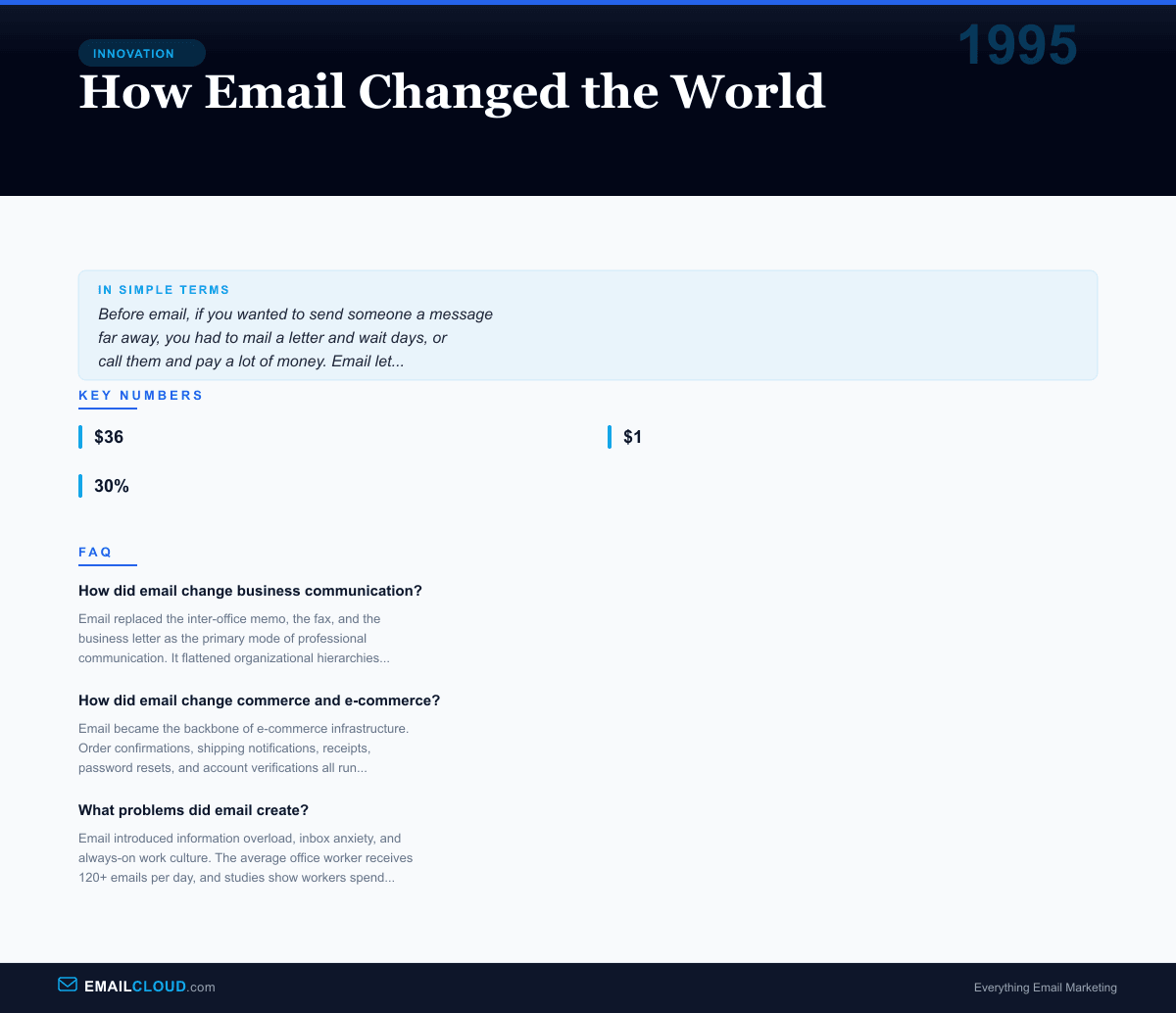
Email marketing, an industry that generates an estimated $36 in revenue for every $1 spent, grew directly from this commercial infrastructure. Once businesses had their customers’ email addresses (from transactions), the leap to sending promotional messages was short and obvious. For better or worse, the marketing email is a direct descendant of the order confirmation.
How Email Changed Media
The newsletter, once a niche format for industry insiders and hobbyists, became one of the defining media formats of the 2020s. But newsletters have been part of email since the beginning — the earliest email lists on ARPANET were essentially newsletters. What changed was the economics. Platforms like Substack, Beehiiv, and ConvertKit made it possible for individual writers to build subscriber bases of thousands or millions and monetize them directly. The newsletter became an alternative to traditional media, with individual authors rivaling established publications in reach and influence.
Email also transformed how news organizations communicated with their audiences. Press releases, once distributed by fax and wire services, moved to email. News alerts — breaking news delivered directly to your inbox — became a standard feature of every major publication. The morning newsletter briefing became a daily ritual for millions of readers, replacing the morning newspaper for a generation that consumed news on screens.
The Problems Email Created
Email’s gifts came with costs that we’re still reckoning with. Information overload — a term that barely existed before email — became a defining condition of modern work life. The average office worker receives over 120 emails per day. Studies consistently find that workers spend 25-30% of their workday reading, writing, and managing email. A tool designed to make communication more efficient became, paradoxically, one of the biggest drains on workplace productivity.
The always-on work culture that email enabled — and that mobile email via BlackBerry supercharged — blurred the boundaries between work and personal time in ways that researchers have linked to increased stress, burnout, and diminished well-being. The expectation of rapid response, the anxiety of an overflowing inbox, the guilt of unread messages — these are distinctly modern afflictions, and email is their origin.
The Inbox Zero movement, email-free Fridays, and the periodic declarations that email is dead are all symptoms of a society grappling with a communication tool that works too well. Email is so efficient, so frictionless, so universally available that it generates more communication than humans can comfortably process. The bottleneck is no longer the technology — it’s us.
The Quiet Revolution
Email didn’t change communication. Email changed everything. It changed how we work, how we shop, how we maintain relationships, how we organize politically, how we consume media, and how we experience stress. It did all of this gradually, without a manifesto or a dramatic rupture. One day we were mailing letters and waiting. The next day — or so it felt — we were drowning in 120 messages a day and couldn’t imagine life without it. The revolution happened so quietly that most people didn’t notice until it was over. And despite every prediction of its demise, email remains the backbone of digital communication. Not because it’s perfect. Because nothing else can replace what it does.
Infographic
Share this visual summary. Right-click to save.
Related Events
Frequently Asked Questions
How did email change business communication?
Email replaced the inter-office memo, the fax, and the business letter as the primary mode of professional communication. It flattened organizational hierarchies by allowing anyone to contact anyone directly, enabled remote work by making location irrelevant to communication, and accelerated decision-making by compressing the feedback loop from days to minutes.
How did email change commerce and e-commerce?
Email became the backbone of e-commerce infrastructure. Order confirmations, shipping notifications, receipts, password resets, and account verifications all run on transactional email. Without reliable email delivery, the entire online shopping experience — from purchase to delivery confirmation — would not function as we know it.
What problems did email create?
Email introduced information overload, inbox anxiety, and always-on work culture. The average office worker receives 120+ emails per day, and studies show workers spend roughly 28% of their workday managing email. The erosion of work-life boundaries — enabled by mobile email — has been linked to increased stress and burnout.
Stay ahead of the inbox
Weekly tips on deliverability, automation, and growing your list. No spam, ever.
No spam. Unsubscribe any time. We respect your inbox.