2001: How Email Became a Lifeline in Global Crises
On the morning of September 11, 2001, the telephone network in the northeastern United States collapsed under the weight of the largest simultaneous call volume in American history. Millions of people picked up their phones to call family, friends, and colleagues — and heard nothing. Busy signals. Failed connections. Dead air. The circuit-switched telephone infrastructure, designed for normal traffic patterns, simply could not handle a nation of 280 million people trying to make phone calls at the same time.
Email got through.
Not instantly. Not without delays. The internet slowed to a crawl as traffic surged across every channel — web, email, instant messaging. But email, built on packet-switched networks that could route data around congestion points, continued to function when voice calls could not. In those first hours of confusion and fear, email became the communication lifeline for millions of people. It was not the first time email had served this role during a crisis, and it would not be the last. But September 11 was the moment when email’s resilience became publicly visible — and when governments, organizations, and individuals began to understand that email was not just a convenience but critical infrastructure.
The Simple Version: When disasters happen, phone lines get jammed because too many people try to call at once. Email works differently — it breaks messages into little pieces that can squeeze through even when the internet is slow. On 9/11, during hurricanes, and during COVID-19, email kept working when phones did not. That is why governments and companies now rely on email to reach people during emergencies.
September 11 and the Email Surge
The September 11 attacks tested every communication system in the United States simultaneously. The destruction of the World Trade Center towers knocked out a major telecommunications hub in lower Manhattan — Verizon’s switching center at 140 West Street, which handled hundreds of thousands of phone lines and significant internet traffic. Cell towers in the area were destroyed or overwhelmed. Landline circuits were saturated.
Email traffic across the internet surged to unprecedented levels. AOL, which at the time had more than 30 million subscribers, reported a massive increase in email and instant messaging activity. Yahoo and Hotmail experienced similar surges. Corporate email systems strained under the load as employees sent frantic messages checking on colleagues, particularly those who worked in or near the World Trade Center.
The emails of September 11 form an extraordinary historical record. Some are businesslike — “All employees should remain at home until further notice.” Some are desperate — “Please tell me you’re okay.” Some relay practical information — office closures, transportation alternatives, blood donation centers. Some are simply human — messages sent into the void, hoping for a reply that would confirm someone was alive.
What made email function when phones failed was architectural. The telephone network of 2001 was primarily circuit-switched: each phone call required a dedicated connection between caller and receiver. When all available circuits were in use, no new calls could connect. Email, by contrast, is asynchronous and packet-switched. A message is broken into data packets that are routed independently through the network. If the network is congested, packets are queued and delivered when bandwidth becomes available. The email might arrive in thirty seconds instead of three, but it arrives. There is no “busy signal” equivalent in email — only delay.
Natural Disasters and the Communication Gap (2004-2019)
September 11 established a pattern that would repeat during every major disaster of the following two decades: phone networks overwhelm, email persists, and digital communication becomes the primary channel for both official notifications and personal welfare checks.
The 2004 Indian Ocean Tsunami. In the aftermath of the tsunami that killed over 230,000 people across fourteen countries, email became a critical tool for international relief coordination and family notification. With telecommunications infrastructure destroyed across vast coastal areas, satellite-linked email stations were among the first communication tools deployed by relief organizations. The International Committee of the Red Cross processed millions of “safe and well” notifications, many delivered via email.
Hurricane Katrina (2005). When Katrina devastated the Gulf Coast, email became the primary communication channel for displaced residents trying to locate family members. The Federal Emergency Management Agency (FEMA) relied heavily on email for coordination with state and local agencies. Universities used email to notify displaced students about transfer options and enrollment accommodations. The failure of email communication in some instances — FEMA officials who did not check email quickly enough, local systems that went offline — became part of the post-Katrina critique of disaster response.
The 2011 Japan Earthquake and Tsunami. Japan’s March 11, 2011, earthquake and tsunami overwhelmed the country’s cellular networks, but internet-based communication — email, social media, and messaging apps — continued to function. Japanese cell carriers processed record email volumes through their mobile email systems (a technology far more developed in Japan than elsewhere). Google launched its Person Finder tool, which allowed users to search for and report the status of individuals via web and email.
Hurricane Maria (2017). When Hurricane Maria destroyed Puerto Rico’s electrical grid and telecommunications infrastructure, email became accessible only to those with generator power and satellite internet connections. The communications blackout highlighted a critical limitation: email requires electricity and network infrastructure, and when both are destroyed, email fails alongside everything else. The disaster prompted renewed discussion about communication resilience and the need for redundant systems.
The Government Email Infrastructure
The repeated demonstration of email’s importance during crises prompted governments worldwide to develop formal email-based emergency communication systems.
The United States Wireless Emergency Alerts (WEA) system, launched in 2012, uses cell broadcast technology rather than email. But the broader government communication infrastructure relies heavily on email. Federal agencies maintain massive email distribution lists for stakeholders, press, and the public. The Centers for Disease Control and Prevention’s Health Alert Network uses email as a primary channel for distributing clinical guidance during health emergencies. The Department of Homeland Security’s National Terrorism Advisory System includes email notification as a core distribution method.
State and local governments developed their own email-based emergency notification systems. Universities built campus alert systems that combined email, text message, and public address notifications. The assumption underlying all of these systems was the same one that September 11 had validated: in a crisis, email works.
COVID-19: The Pandemic Email Explosion (2020-2021)
If September 11 proved email’s resilience during an acute crisis, the COVID-19 pandemic proved its indispensability during a sustained one. When the world locked down in March 2020, email became the connective tissue holding organizations, communities, and economies together.
The immediate effect was a staggering increase in email volume. Every company with an email list — every retailer, airline, hotel chain, restaurant, gym, dentist office, SaaS provider, and nonprofit — sent an email in March 2020 explaining their COVID-19 response. The meme “I didn’t realize how many email lists I was on until COVID” became one of the defining observations of the early pandemic. Marketing email send volume increased by an estimated 40-60% in March and April 2020 compared to the same period in 2019.
The content of pandemic-era email communications fell into several categories. Policy update emails from businesses — “Our stores are closing,” “We’re moving to curbside pickup,” “Here are our cleaning protocols” — were the first wave. Internal communications surged as organizations tried to coordinate remote workforces that had been sent home overnight. Government health communications used email to distribute guidance on masking, testing, and vaccination as it became available. Educational communications from schools and universities used email as the primary channel for informing families about remote learning plans, school closures, and reopening schedules.
The Work-From-Home Email Transformation
The pandemic’s most lasting effect on email may be the normalization of remote work and the corresponding increase in email as a coordination tool. When offices closed, the hallway conversation, the desk drop-by, and the conference room meeting — informal communication channels that had supplemented email in the workplace — disappeared overnight. Email absorbed some of that communication (alongside Zoom, Slack, and Teams), and internal email volume increased measurably.
For many workers, the pandemic era was the first time they experienced email not as one of several workplace communication channels but as the primary one. This intensified the email overload that had been building for years and accelerated the adoption of asynchronous work practices that treat email as a coordination layer rather than a real-time communication tool.
Lessons for Email Infrastructure
The history of email during disasters reveals several consistent patterns. First, email’s packet-switched architecture makes it more resilient than circuit-switched telephone networks during high-demand events, but email still depends on electricity and network infrastructure that can be destroyed by physical disasters. Second, the asynchronous nature of email — the fact that a message can be queued and delivered later — is a strength during crises, allowing communication to continue even when networks are degraded. Third, email’s universal reach — nearly every adult in the developed world has an email address — makes it the most inclusive digital communication channel for emergency notifications.
For organizations that use email to communicate with customers, employees, or constituents, the disaster history carries a practical message: your email infrastructure is emergency infrastructure. The ability to send timely, clear, well-organized email to your entire list on short notice is not just a marketing capability — it is an operational necessity. The organizations that communicated most effectively during COVID-19 were those that already had well-maintained email lists, tested sending infrastructure, and clear internal processes for approving and distributing urgent communications.
The history also carries a warning for email marketers. Every subscriber on your list has experienced the “COVID email flood” — the deluge of messages from every brand they had ever interacted with, all saying essentially the same thing. The lesson was clear: just because you can email everyone does not mean you should. The brands that earned goodwill during the pandemic were those that sent useful, timely information. The brands that damaged their reputations were those that sent tone-deaf promotional emails during a crisis, or that used the pandemic as a pretext for marketing messages dressed up as concern.
Email has proven itself, repeatedly, as infrastructure that holds when other systems break. That reliability is email’s greatest strength — and the reason it remains, after fifty years, the communication channel that the world falls back on when everything else fails.
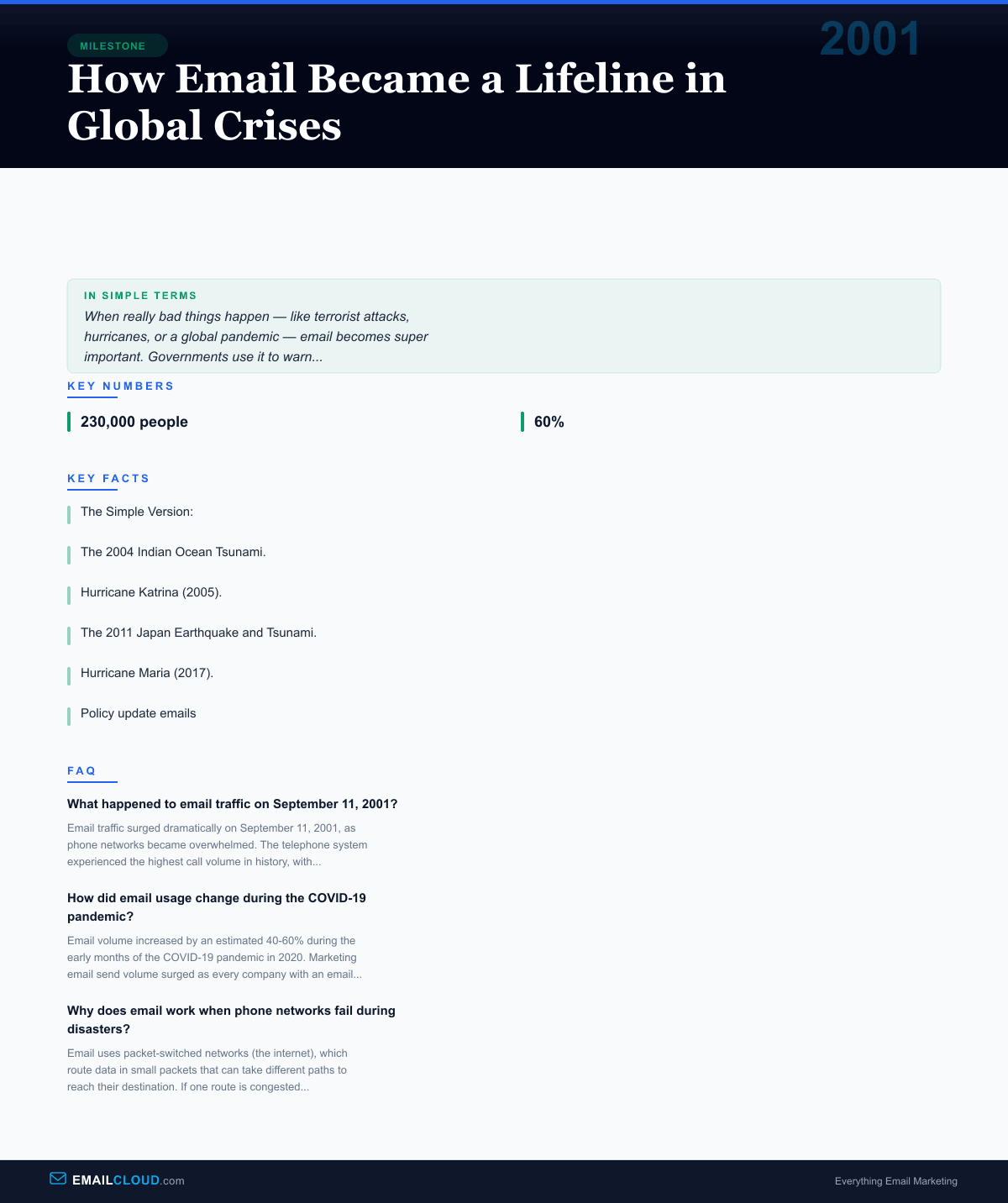
Infographic
Share this visual summary. Right-click to save.
Related Events
Frequently Asked Questions
What happened to email traffic on September 11, 2001?
Email traffic surged dramatically on September 11, 2001, as phone networks became overwhelmed. The telephone system experienced the highest call volume in history, with many calls failing to connect. Email, which uses packet-switched networks rather than circuit-switched connections, continued to function even as networks slowed. Millions of Americans used email to check on family members, inform colleagues, and share information when phone calls could not get through.
How did email usage change during the COVID-19 pandemic?
Email volume increased by an estimated 40-60% during the early months of the COVID-19 pandemic in 2020. Marketing email send volume surged as every company with an email list sent COVID-19 policy updates. Remote work increased internal email traffic. Government agencies used email for public health communications. The pandemic also accelerated the adoption of email-based services for healthcare, education, and government services that had previously been handled in person.
Why does email work when phone networks fail during disasters?
Email uses packet-switched networks (the internet), which route data in small packets that can take different paths to reach their destination. If one route is congested or damaged, packets find alternative routes. Phone calls traditionally use circuit-switched connections that require a dedicated, continuous connection — when circuits are full, calls simply fail. This architectural difference makes email more resilient during high-traffic events, though it is not immune to network disruption.
Stay ahead of the inbox
Weekly tips on deliverability, automation, and growing your list. No spam, ever.
No spam. Unsubscribe any time. We respect your inbox.