1995: Open Source and Email: How Free Software Built the Email Infrastructure
Here is a remarkable fact about the global email system: the infrastructure that delivers over 300 billion messages per day — the most widely used communication system in human history — is built almost entirely on software that anyone can download, inspect, modify, and redistribute for free.
This isn’t an accident. Email grew up in the same academic and research culture that produced the open-source software movement, and the two have been intertwined from the beginning. The story of open-source email is not just a technology story. It’s a story about what happens when a critical communication system is built on a foundation of shared, community-maintained code.
The Academic Foundation
Email’s open-source roots begin with sendmail. Eric Allman wrote sendmail at the University of California, Berkeley in the early 1980s, and it was distributed as part of BSD Unix — one of the foundational open-source operating systems. BSD’s permissive license meant that anyone could use, modify, and redistribute sendmail without restriction.
This wasn’t a deliberate business strategy or a philosophical statement about software freedom. It was simply how software worked in academic computing. Researchers wrote tools, shared them with colleagues, and those tools propagated through the network of universities and research labs that formed the early internet. Sendmail spread because it was useful and available, not because Allman had a theory about open-source economics.
But the pattern it established was consequential. The internet’s default mail server was open-source from the beginning. Every MTA that followed — qmail, Postfix, Exim — was also open-source. This wasn’t inevitable. There were commercial MTAs (Microsoft Exchange, IBM Lotus Domino, Novell GroupWise), and they captured significant market share in the corporate LAN market. But on the internet itself — on the servers that actually routed email across the global network — open-source was the default from day one.
The Protocol Connection
Email’s open-source dominance is inseparable from its open protocols. SMTP, POP3, and IMAP are open standards, defined in RFCs published by the IETF. Anyone can read the specification and build an implementation. There are no patents to license, no proprietary extensions required for interoperability, no single company that controls the standard.
Open protocols and open-source software reinforce each other. When the protocol is open, multiple implementations can exist and compete on merit. When the best implementations are open-source, they attract community contributions that make them even better. The closed alternatives must justify their cost by offering something the open-source implementations can’t — typically management tools, support contracts, or integration with proprietary ecosystems (like Microsoft Exchange’s deep integration with Outlook and Active Directory).
This dynamic played out clearly in the email market. Open-source MTAs dominated internet mail routing, while commercial products dominated the corporate market where integration with other enterprise systems mattered more than raw protocol handling. The two worlds coexisted, with open-source handling the public infrastructure and commercial products handling the private infrastructure.
The Full Stack
By the early 2000s, every major component of email infrastructure had at least one high-quality open-source option. The full stack looked like this:
Mail Transfer Agents (sending and routing):
- Sendmail — the original, BSD-licensed
- qmail — Dan Bernstein’s security-focused alternative (public domain since 2007)
- Postfix — Wietse Venema’s pragmatic replacement (IBM Public License, later Eclipse Public License)
- Exim — Philip Hazel’s flexible Cambridge creation (GPL)
IMAP/POP3 Servers (mailbox access):
- Dovecot — created by Timo Sirainen in 2002, it quickly became the dominant open-source IMAP server. Dovecot’s combination of performance, standards compliance, and ease of configuration made it the clear leader. It is used by numerous large email providers and hosting companies.
- Courier-IMAP — part of the Courier Mail Server project, popular in the qmail ecosystem
- Cyrus IMAP — developed at Carnegie Mellon University, used in large academic deployments
Spam Filtering:
- SpamAssassin — the Apache project that became the most widely deployed spam filter
- Rspamd — a more modern, high-performance alternative written in C
- DSPAM — statistical spam filter using Bayesian analysis
Webmail:
- Roundcube — clean, modern webmail interface, widely deployed on hosting platforms
- SquirrelMail — an earlier PHP-based webmail client, popular in the 2000s
- Rainloop — lightweight, modern webmail alternative
Mailing List Management:
- Mailman — the dominant open-source mailing list manager, used by thousands of organizations
- ezmlm — the mailing list manager from the qmail ecosystem
- Sympa — multilingual mailing list manager popular in European academic institutions
Supporting Tools:
- ClamAV — open-source antivirus engine, commonly integrated with mail servers
- Amavis — content filter interface between MTAs and spam/virus scanners
- OpenDKIM — implementation of DKIM email authentication
- SPF libraries — implementations of Sender Policy Framework checking
- Fail2ban — intrusion prevention tool that monitors mail server logs for brute-force attacks
This stack was remarkable for its completeness. An organization could build a fully functional, production-grade email system using nothing but open-source software. No licensing fees, no vendor lock-in, no dependency on a single company’s continued existence or goodwill.
The Business Models
If the software was free, how did businesses make money from it? The answer is that open-source email infrastructure spawned multiple business models, each extracting value from a different layer.
Hosting and managed services. Companies ran open-source email software on behalf of customers who didn’t want to manage it themselves. Web hosting providers bundled Exim, Dovecot, SpamAssassin, and Roundcube into hosting packages. Managed email providers ran Postfix clusters for businesses. The software was free; the infrastructure and expertise to run it were not.
Cloud filtering. Companies like those in the cloud email filtering space built spam and virus filtering services on top of open-source foundations. SpamAssassin provided the detection engine; the company provided the infrastructure, the expertise, and the convenience.
Commercial extensions. Some open-source projects offered commercial versions with additional features. Sendmail, Inc. sold enterprise management tools on top of the open-source sendmail core. Dovecot’s creator, Timo Sirainen, founded a company (later acquired by Open-Xchange) offering commercial support and enterprise features.
Support and consulting. Red Hat’s business model — give the software away, sell support and expertise — worked for email infrastructure too. Companies paid for help deploying, configuring, and maintaining complex email systems built on open-source components.
Complementary products. Companies built proprietary products that integrated with open-source email infrastructure. Commercial anti-spam products, archiving solutions, compliance tools, and email security gateways all sat alongside (and often on top of) open-source MTAs and IMAP servers.
The Tensions
The relationship between open-source email software and the businesses built on it was not always harmonious. Several tensions recurred:
Sustainability. Writing and maintaining critical infrastructure software for free is noble but not economically sustainable in the long term. Several major open-source email projects depended heavily on single maintainers (Philip Hazel for Exim, Wietse Venema for Postfix) whose continued involvement was not guaranteed. The OpenSSL Heartbleed vulnerability in 2014 exposed this problem across the open-source ecosystem: software that the entire internet depended on was maintained by a tiny, underfunded team.
Licensing conflicts. qmail’s restrictive licensing delayed its adoption by years. The Affero GPL (AGPL) used by some projects created complications for companies that wanted to offer the software as a service. Even seemingly permissive licenses sometimes conflicted with corporate legal requirements. The licensing landscape of open-source email software was (and remains) a patchwork of different terms and conditions.
Quality control. Open-source email software was generally well-maintained, but the quality varied. Some projects had excellent documentation (Exim’s manual was exemplary). Others had documentation that was sparse or outdated. Some had responsive security teams. Others took weeks to patch disclosed vulnerabilities. The lack of a commercial entity with a reputation to protect meant that quality standards depended entirely on community norms and individual maintainer discipline.
Competition with cloud. The biggest threat to the open-source email ecosystem hasn’t come from commercial email servers. It’s come from cloud email services that make the entire self-hosted model irrelevant. Why run your own Postfix/Dovecot/SpamAssassin stack when Google Workspace or Microsoft 365 will handle everything for a per-user monthly fee? The convenience of cloud email has steadily eroded the market for self-hosted solutions, reducing the user base (and therefore the contributor base) for open-source email infrastructure.
Email as Public Utility
The philosophical argument for open-source email infrastructure is that email is too important to be controlled by any single entity. It is the closest thing the internet has to a universal communication standard — the one protocol that connects every platform, every device, every organization. If the infrastructure that implements this standard is proprietary, it creates dependencies and vulnerabilities that can be exploited by the companies that control it.
Open-source email infrastructure ensures that email remains genuinely decentralized. Anyone can run a mail server. Anyone can build an email client. Anyone can create an email service. The barriers are technical, not legal or commercial. This openness is what prevents email from becoming a walled garden controlled by a few dominant platforms — though the concentration of consumer email in Gmail, Outlook, and Apple Mail means that the practical decentralization of email is less robust than the technical decentralization might suggest.
The Current State
As of the mid-2020s, open-source email infrastructure remains the backbone of email delivery, even as cloud services have captured the majority of end-user mailboxes. The DNS blocklists that protect against spam, the authentication protocols that verify sender identity, the IMAP servers that sync mailboxes across devices, and the MTAs that route messages between servers are still overwhelmingly open-source.
The email ecosystem stands as one of the most successful examples of open-source infrastructure in the history of computing. A system built largely by volunteers and academics, maintained by a global community, released under a patchwork of free licenses, and running the communication backbone of the global economy. No other open-source ecosystem touches as many people as frequently as email does.
That foundation is worth understanding and, we’d argue, worth protecting. When we recommend email tools and services in our reviews, we pay attention to which products build on and contribute back to the open-source ecosystem that makes email work.
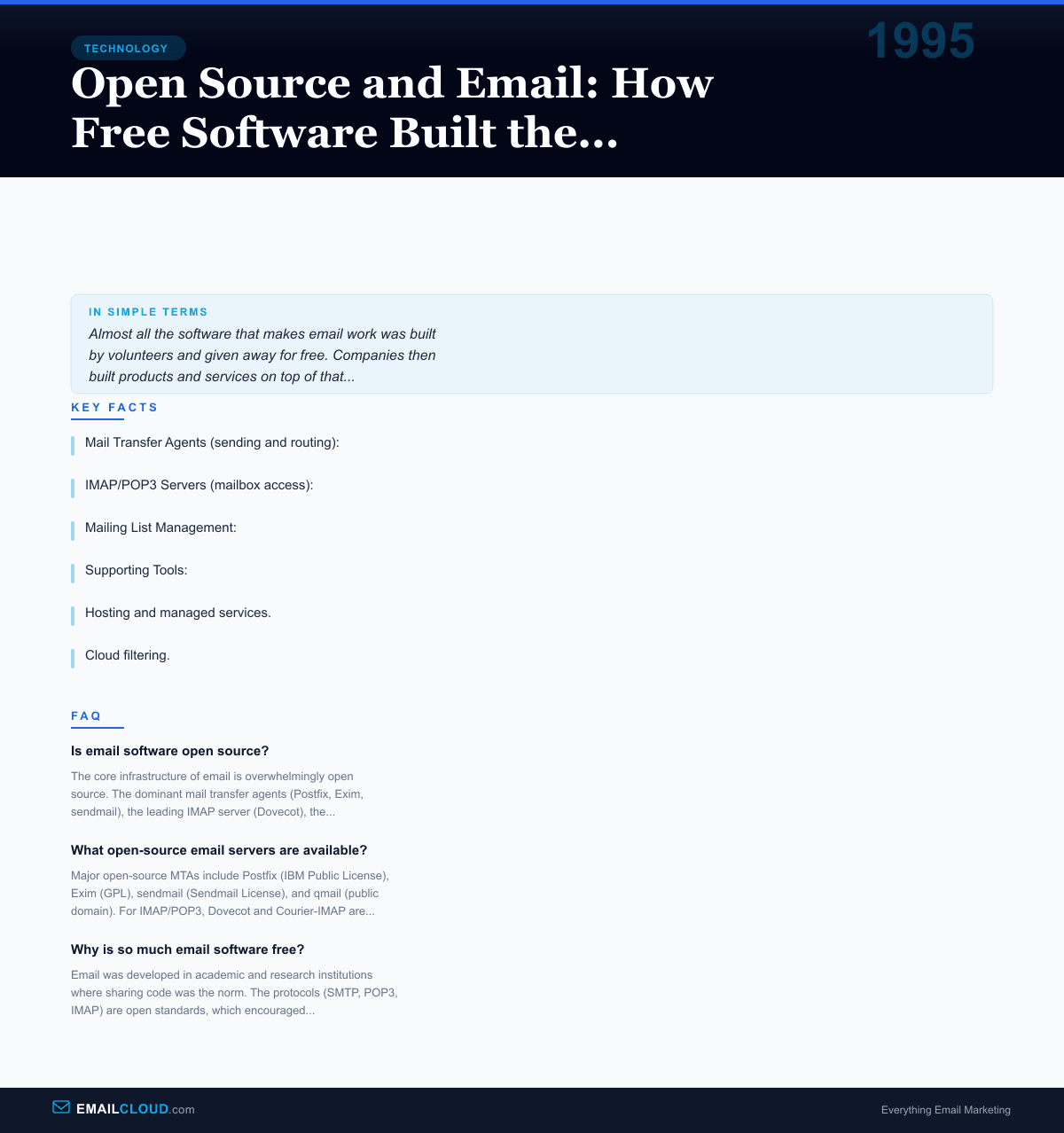
Infographic
Share this visual summary. Right-click to save.
Related Events
Frequently Asked Questions
Is email software open source?
The core infrastructure of email is overwhelmingly open source. The dominant mail transfer agents (Postfix, Exim, sendmail), the leading IMAP server (Dovecot), the most widely deployed spam filter (SpamAssassin), and popular webmail clients (Roundcube, Rainloop) are all open source. However, many commercial email services and clients are proprietary.
What open-source email servers are available?
Major open-source MTAs include Postfix (IBM Public License), Exim (GPL), sendmail (Sendmail License), and qmail (public domain). For IMAP/POP3, Dovecot and Courier-IMAP are the leading options. For webmail, Roundcube and Rainloop are popular. SpamAssassin handles spam filtering. All are free to use and modify.
Why is so much email software free?
Email was developed in academic and research institutions where sharing code was the norm. The protocols (SMTP, POP3, IMAP) are open standards, which encouraged open-source implementations. Email was also seen as a public utility — infrastructure too important to be controlled by any single company. This culture of openness persists in the email ecosystem.
Stay ahead of the inbox
Weekly tips on deliverability, automation, and growing your list. No spam, ever.
No spam. Unsubscribe any time. We respect your inbox.