1995: The ISP Email Era — When Your Address Died If You Switched Providers
There was a time — and it lasted longer than anyone who lived through it wants to admit — when your email address belonged to your internet service provider. Not to you. To them. Your identity on the internet, the address you printed on business cards and gave to friends and signed up for mailing lists with, was a string like jsmith42@earthlink.net or themartins@comcast.net or dadsbigfish@bellsouth.net. And the moment you canceled your internet service or switched to a different provider, that address vanished. Every contact you’d built, every account you’d registered, every friend who had your address in their address book — all of it, gone.
This was the ISP email era, and it held American internet users hostage for the better part of a decade.
How It Worked
When you signed up for internet service in the mid-to-late 1990s, your ISP provided two things: a dial-up (and later broadband) connection to the internet, and an email address on their mail server. EarthLink gave you @earthlink.net. Comcast gave you @comcast.net. SBC (later AT&T) gave you @sbcglobal.net. BellSouth gave you @bellsouth.net. Charter gave you @charter.net. Cox gave you @cox.net. Prodigy gave you @prodigy.net. Mindspring gave you @mindspring.com.
The email setup process itself was an ordeal. You’d receive a sheet of paper — or if you were lucky, a setup wizard on a CD-ROM — with the incoming and outgoing mail server addresses, the port numbers, and your username and password. You’d enter these settings into your email client (Outlook Express, Eudora, Netscape Mail, or whatever you preferred) and hope you typed everything correctly. If you got a single character wrong, your email simply wouldn’t work, and you’d be on hold with tech support for 45 minutes trying to figure out why.
The major ISP email providers of the era formed a surprisingly long list. Beyond the well-known names, there were regional ISPs like Mindspring, NetCom, Concentric, Erols, and dozens of local providers that served individual cities or regions. Each one issued its own email addresses, and each one maintained its own mail servers with varying degrees of reliability.
The Lock-In Effect
ISPs understood, either instinctively or deliberately, that email created powerful customer lock-in. Once you’d been using jsmith@earthlink.net for two years — giving it out to every colleague, friend, family member, online retailer, and mailing list — the cost of switching ISPs wasn’t just the monthly bill. It was the catastrophic loss of your email address.
This lock-in was real and measurable. Studies from the late 1990s and early 2000s consistently found that one of the top reasons consumers stayed with their current ISP, even when dissatisfied with price or service quality, was unwillingness to change their email address. People endured terrible connection speeds, frequent outages, rude customer service, and above-market pricing because the alternative — losing their email identity — was worse.
The problem was especially acute for small businesses that had built customer relationships around ISP email addresses. A plumber who had jimtheplumber@earthlink.net on every truck, flyer, and Yellow Pages ad couldn’t simply switch ISPs when EarthLink raised its prices. The email address was part of the business identity.
The Family Account Phenomenon
Most ISPs offered multiple email addresses per account — typically five to seven “sub-accounts” under the primary account. This led to a uniquely 1990s phenomenon: the family email configuration. Dad got the main address (martinez@comcast.net), Mom got a sub-account (martinez2@comcast.net or susanm@comcast.net), and the kids got whatever was left (skaterboy98@comcast.net).
These family email setups created their own problems. Dad’s account was the “master” account, which meant Dad could — and sometimes did — read everyone else’s email. Privacy within the household was a function of trust and technical ignorance. Teenagers with sensitive correspondence learned quickly to seek alternative email addresses, which is one reason Hotmail and Yahoo Mail became so popular with younger users.
The ISP Email Graveyard
The consolidation of the American ISP industry created waves of email displacement. When AT&T acquired BellSouth in 2006, millions of @bellsouth.net addresses were migrated (sometimes poorly) to AT&T’s systems. When Time Warner Cable merged with Charter Communications in 2016, @twc.com and @roadrunner.com addresses entered an uncertain future. Each merger, acquisition, and bankruptcy in the ISP industry left behind a trail of orphaned email addresses and confused users.
Some ISPs handled these transitions gracefully, maintaining legacy email domains for years after acquisitions. Others shut down email services with minimal notice, leaving users scrambling to notify their contacts. The Prodigy email shutdown in 1999, when the pioneering online service finally closed, left hundreds of thousands of users without email addresses they’d used for nearly a decade.
The experience of losing an ISP email address was genuinely distressing for people who went through it. There was no way to set up an automatic redirect, no forwarding service, no gradual transition. One day your email worked; the next day it didn’t. Messages sent to your old address bounced. People trying to reach you couldn’t. Accounts registered with that address became inaccessible.
The Webmail Liberation
Hotmail’s launch in 1996 was the beginning of the end for ISP email dominance, though it took nearly a decade for the shift to complete. Hotmail’s key insight — and the insight that Yahoo Mail and later Gmail would build on — was that an email address should be portable. It should belong to the user, not to the access provider. You could switch ISPs, move across the country, change computers, and your email address would stay the same.
This portability was genuinely revolutionary for people who’d lived through the ISP email era. The idea that you could have a single email address for life, independent of which company provided your internet connection, solved a problem that had caused real pain for millions of people. Gmail’s launch in 2004, with its generous storage and powerful search, was the tipping point. By 2006, the majority of new email accounts created in the United States were webmail accounts, not ISP accounts.
The Holdouts
And yet, ISP email never fully died. As of 2026, millions of Americans still use ISP email addresses as their primary email. The demographics skew older — these are often people who set up their @comcast.net or @att.net address in the late 1990s or early 2000s and never saw a reason to change. Their address works. Their contacts have it. Why fix what isn’t broken?
AT&T still maintains email service for @att.net, @sbcglobal.net, and @bellsouth.net addresses, though Yahoo now manages the backend. Comcast still supports @comcast.net (branded as Xfinity email). Cox still supports @cox.net. These services persist because shutting them down would alienate long-term customers.
For email marketers, ISP email addresses are a notable segment. They tend to belong to older, less tech-savvy users who check email through the ISP’s webmail portal or a locally installed client like Outlook. Deliverability to these domains follows its own rules, and messages need to render well in clients that may not support modern HTML email features. Run your next campaign through our Spam Word Checker to make sure it lands cleanly in every inbox, ISP-hosted or otherwise.
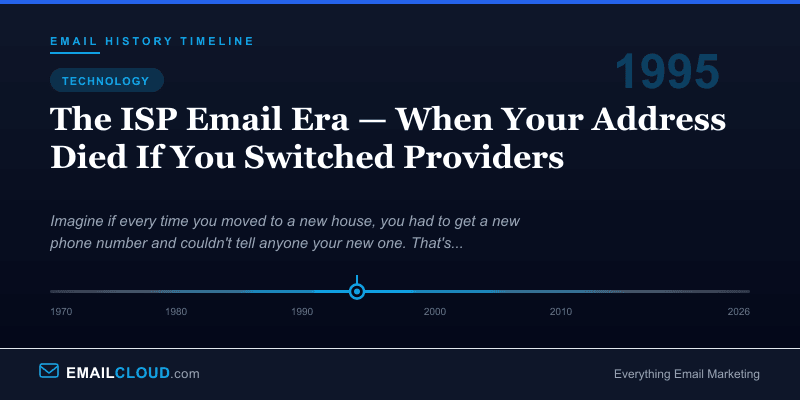
Infographic
Share this visual summary. Right-click to save.
Related Events
Frequently Asked Questions
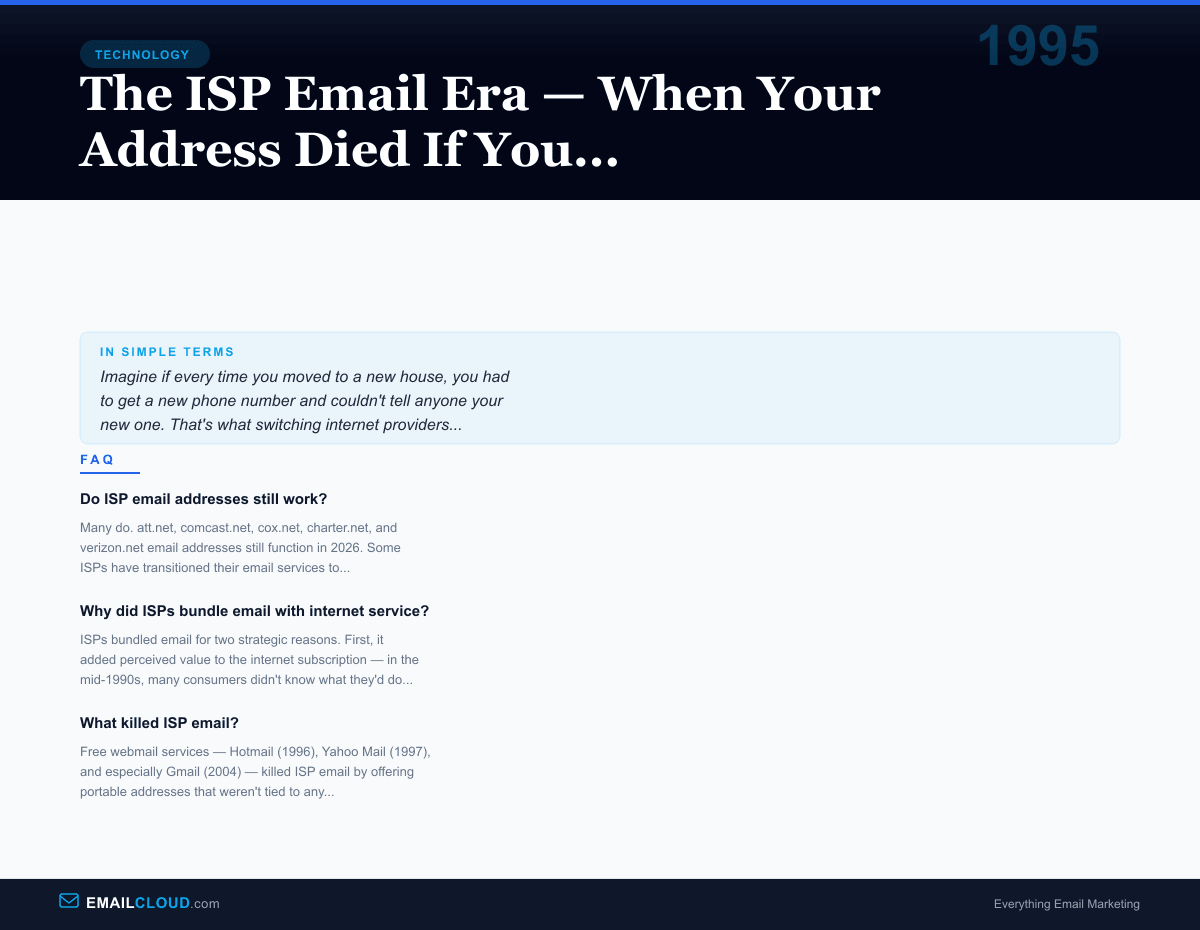
Do ISP email addresses still work?
Many do. att.net, comcast.net, cox.net, charter.net, and verizon.net email addresses still function in 2026. Some ISPs have transitioned their email services to third-party providers — AT&T email, for example, is now managed by Yahoo. However, the addresses themselves remain active for existing users, and some ISPs still issue new email addresses to subscribers.
Why did ISPs bundle email with internet service?
ISPs bundled email for two strategic reasons. First, it added perceived value to the internet subscription — in the mid-1990s, many consumers didn't know what they'd do with internet access, and email was an easy-to-understand benefit. Second, it created switching costs. Once a customer's email address was tied to their ISP, changing providers meant losing that address, making customers less likely to leave.
What killed ISP email?
Free webmail services — Hotmail (1996), Yahoo Mail (1997), and especially Gmail (2004) — killed ISP email by offering portable addresses that weren't tied to any service provider. Users could switch ISPs freely without losing their email address. By the mid-2000s, most new internet users chose webmail addresses over their ISP-provided ones.
Stay ahead of the inbox
Weekly tips on deliverability, automation, and growing your list. No spam, ever.
No spam. Unsubscribe any time. We respect your inbox.