1989: Lotus Notes: The Enterprise Email System Everyone Loved to Hate
In the taxonomy of enterprise software, there is a special category reserved for applications that are simultaneously indispensable and despised. Software that a company cannot function without but that its employees curse under their breath every time they use it. Software that does everything but does nothing elegantly. Software that IT departments defend with statistics about uptime and integration while end users fantasize about throwing their monitors out the window.
For two decades, the undisputed champion of this category was Lotus Notes.
Notes was the enterprise groupware platform that defined corporate collaboration from 1989 into the 2010s. At its peak, it served over 145 million users across some of the world’s largest organizations — IBM, Siemens, the U.S. Department of Defense, major banks, insurance companies, pharmaceutical firms, and government agencies on every continent. It handled email, calendaring, task management, document databases, workflow applications, and thousands of custom business applications that enterprises had built on its platform over decades.
And almost everyone who used it hated it.
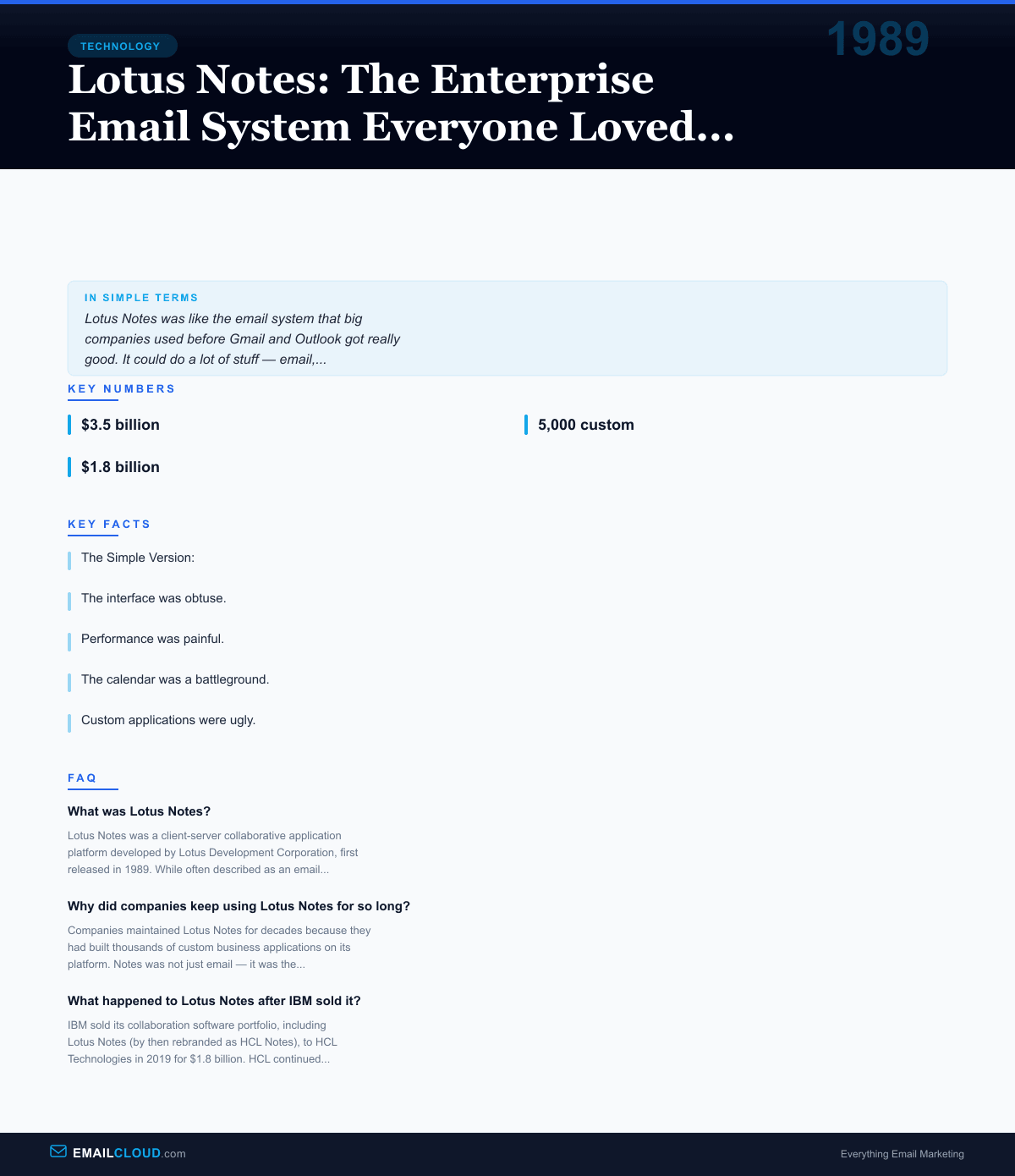
The Simple Version: Lotus Notes was a computer program that big companies used for email and lots of other work stuff starting in 1989. It could do almost anything — email, calendars, databases, custom apps — but it was really hard to use and looked old-fashioned. Companies kept using it for 20+ years because they had built so many important work tools on top of it that switching to something else was incredibly expensive and complicated. It is the ultimate example of a technology that survived on switching costs rather than user satisfaction.
Ray Ozzie’s Vision (1984-1989)
Lotus Notes was the creation of Ray Ozzie, a programmer who had worked on PLATO Notes — a collaborative messaging system on the PLATO educational computing platform at the University of Illinois. Ozzie saw the potential for a similar system adapted for the corporate world: a platform that could combine messaging, document sharing, and collaborative databases into a single application that worked across distributed offices.
Ozzie founded Iris Associates in 1984 to build this vision. The company developed Notes for five years before releasing version 1.0 in 1989, marketed and sold through a partnership with Lotus Development Corporation (the company behind the iconic Lotus 1-2-3 spreadsheet). The initial release supported email, discussion databases, and a replication system that could synchronize data across servers in different locations — a critical feature in an era when most corporate networks were islands with no internet connectivity.
The replication capability was, in retrospect, Notes’ killer feature. In a world before always-on internet connections, the ability for a salesperson in Tokyo to work on their laptop offline, then connect to the hotel phone line and synchronize their changes with the corporate server in New York, was genuinely revolutionary. No competing product offered anything comparable. Notes was designed for the distributed enterprise at a time when most software assumed a persistent network connection.
The Groupware Era (1990-1999)
Lotus Development Corporation acquired Iris Associates (and Notes) fully in 1994. The following year, IBM acquired Lotus for $3.5 billion — at the time, the largest acquisition in software history. IBM wanted Notes. Specifically, IBM wanted the enterprise relationships and the platform’s installed base as a foundation for its services and consulting businesses.
Under IBM’s ownership, Notes expanded aggressively. The Domino server (Notes’ server component, renamed from “Lotus Notes Server” in 1996) became one of the most widely deployed enterprise application platforms in the world. Companies did not just use Notes for email — they built entire business process ecosystems on it. Human resources applications. Expense reporting systems. Customer relationship databases. Compliance tracking tools. Knowledge management repositories. Helpdesk ticketing systems. Document approval workflows.
The depth of these custom applications was both Notes’ greatest strength and the primary reason companies could never leave. A large enterprise might have 500, 1,000, or even 5,000 custom Notes databases powering critical business processes. Each one would need to be recreated in whatever replacement platform the company chose. The migration cost was not just the new software license — it was the years of consulting, development, and testing required to rebuild thousands of bespoke applications. For many organizations, the math simply did not work: the cost of migrating exceeded the cost of staying, year after year, for a decade or more.
Why Everyone Hated It
Despite its capabilities, Lotus Notes accumulated a level of user hostility that is rare in enterprise software. The complaints were consistent and vociferous:
The interface was obtuse. Notes’ email interface bore little resemblance to the increasingly polished consumer email clients that users encountered outside of work. Where Gmail offered clean simplicity and Outlook offered familiar Microsoft conventions, Notes presented a dense, icon-heavy interface with non-standard navigation, inconsistent terminology (Notes called email messages “memos”), and a learning curve that frustrated new users and irritated experienced ones.
Performance was painful. Notes had a reputation for being slow — slow to open, slow to search, slow to render, slow to synchronize. Part of this was architectural (the client was a thick application doing significant local processing), and part was environmental (many enterprises deployed Notes on underpowered hardware with insufficient memory). But the lived experience for users was consistent: opening Notes meant waiting, and searching for an email meant waiting longer.
The calendar was a battleground. Notes’ calendar and scheduling functionality was particularly reviled. Meeting invitations behaved unpredictably. Recurring events had well-documented bugs. Time zone handling was inconsistent. Free/busy lookups were unreliable. For an application whose primary purpose included scheduling, the calendar’s unreliability was a particularly painful failure.
Custom applications were ugly. The Notes databases that enterprises built on the platform were functionally powerful but visually dated. Most were designed in the 1990s or early 2000s and never updated their interfaces. They used fixed-width layouts, tiny fonts, and navigation patterns that bore no resemblance to modern web applications. Users who interacted with sleek consumer web applications all day were then forced to enter expense reports in a Notes database that looked like it was designed in 1997 — because it was.
The Long, Slow Decline (2005-2019)
Notes’ decline began not with a dramatic failure but with the emergence of superior alternatives for its individual components. Microsoft Exchange and Outlook captured the enterprise email market. SharePoint absorbed the document management use case. Salesforce took CRM. Google Workspace (then Google Apps) offered a cloud-based alternative that required no on-premises infrastructure. Each competitor was better at its specific function than Notes was at any of its many functions.
IBM recognized the threat and attempted to modernize. Notes 8.0 (2007) introduced a new interface built on the Eclipse platform, with a more modern look and support for composite applications. Notes 9.0 (2013) added social features and improved integration. IBM also launched Verse, a cloud-based email service designed to be a modern front end for the Domino server. But each modernization effort was incremental, and the underlying architecture — built for the networked office of the late 1980s — showed its age.
The numbers told the story. From a peak of over 145 million users in the mid-2000s, the Notes installed base contracted steadily. Major enterprises began multiyear migration projects to Microsoft 365 or Google Workspace. Each migration was expensive and painful — confirming the switching-cost thesis that had kept companies on Notes for so long — but the cost of maintaining an increasingly obsolete platform eventually exceeded the cost of leaving it.
The HCL Acquisition (2019)
In 2019, IBM sold its entire collaboration software portfolio — including Notes, Domino, Sametime (instant messaging), and Connections (social networking) — to HCL Technologies, an Indian IT services company, for $1.8 billion. The sale acknowledged what had been obvious for years: Notes was no longer strategic for IBM.
HCL, to the surprise of many industry observers, invested in the product. Domino V12 (2021) and subsequent releases focused on modernization, security, and cloud deployment options. HCL positioned Notes/Domino as a secure, privacy-focused collaboration platform for regulated industries where the data sovereignty concerns of cloud-based alternatives made on-premises deployment attractive.
As of 2026, HCL Notes/Domino remains in production at government agencies, financial institutions, and other organizations with strict data residency requirements. The user base is a fraction of its peak, but it has not reached zero — and given the thousands of custom applications still running on Domino servers, it may never reach zero. Some of those applications are so deeply embedded in business processes that they will outlast the platform itself, running on maintained servers long after the last Notes email is sent.
The Legacy
Lotus Notes’ legacy in email history is paradoxical. It was one of the most important enterprise collaboration platforms ever built — a product that brought email, groupware, and custom application development to organizations that had never had them. Ray Ozzie’s vision of a unified collaboration platform anticipated the “everything app” ambitions of modern platforms by two decades. Notes’ replication system was architecturally ahead of its time. Its security model was robust. Its flexibility was unmatched.
But Notes also demonstrated that capability without usability is not enough. A tool can be powerful, reliable, and deeply integrated into business processes, and still make its users miserable every day. The lesson of Lotus Notes is that switching costs can keep an inferior user experience in place for decades, but they cannot prevent the eventual migration to something better — they can only delay it.
For the email industry, Notes is a reminder that the tools people use shape their relationship with email itself. A generation of knowledge workers formed their impression of email through the Notes interface — and that impression was overwhelmingly negative. How much of the widespread frustration with “email overload” in the 2000s and 2010s was actually frustration with Notes specifically, misattributed to email generally? The question is unanswerable but worth asking. The medium is not the message — but the client is not the medium, either, and the client you use shapes the medium you experience.
Infographic
Share this visual summary. Right-click to save.
Related Events
Frequently Asked Questions
What was Lotus Notes?
Lotus Notes was a client-server collaborative application platform developed by Lotus Development Corporation, first released in 1989. While often described as an email client, Notes was actually a full groupware platform that combined email, calendaring, contact management, instant messaging, and — critically — a custom application development environment built on a document-oriented database. Its versatility made it indispensable to large enterprises; its complexity and dated interface made it widely disliked by end users.
Why did companies keep using Lotus Notes for so long?
Companies maintained Lotus Notes for decades because they had built thousands of custom business applications on its platform. Notes was not just email — it was the foundation for HR workflows, expense reporting, project tracking, compliance databases, and other mission-critical processes. Migrating away from Notes required replacing not just an email client but an entire application ecosystem, which could cost millions of dollars and take years to complete.
What happened to Lotus Notes after IBM sold it?
IBM sold its collaboration software portfolio, including Lotus Notes (by then rebranded as HCL Notes), to HCL Technologies in 2019 for $1.8 billion. HCL continued to develop and support the product, releasing new versions and positioning it as a secure enterprise collaboration platform. As of 2026, HCL Notes/Domino remains in use at some organizations, though its market share has contracted significantly as companies migrate to Microsoft 365 and Google Workspace.
Stay ahead of the inbox
Weekly tips on deliverability, automation, and growing your list. No spam, ever.
No spam. Unsubscribe any time. We respect your inbox.