2000: The Great MTA Wars: Sendmail vs qmail vs Postfix vs Exim
The late 1990s and 2000s saw one of the most consequential technology competitions in internet history — and almost nobody outside the systems administration community noticed it happening. While the browser wars between Netscape and Internet Explorer captured headlines, and the operating system rivalry between Linux and Windows commanded conference keynotes, a quieter battle was reshaping the infrastructure that delivered billions of messages every day.
Four mail transfer agents — sendmail, qmail, Postfix, and Exim — competed for dominance, each representing a fundamentally different philosophy about how software should be designed. The outcome of that competition shaped the email infrastructure we still rely on today.

The Four Philosophies
What made the MTA wars interesting wasn’t just technical competition. Each MTA embodied a distinct worldview about software engineering, and the debates between their communities were as much philosophical as practical.
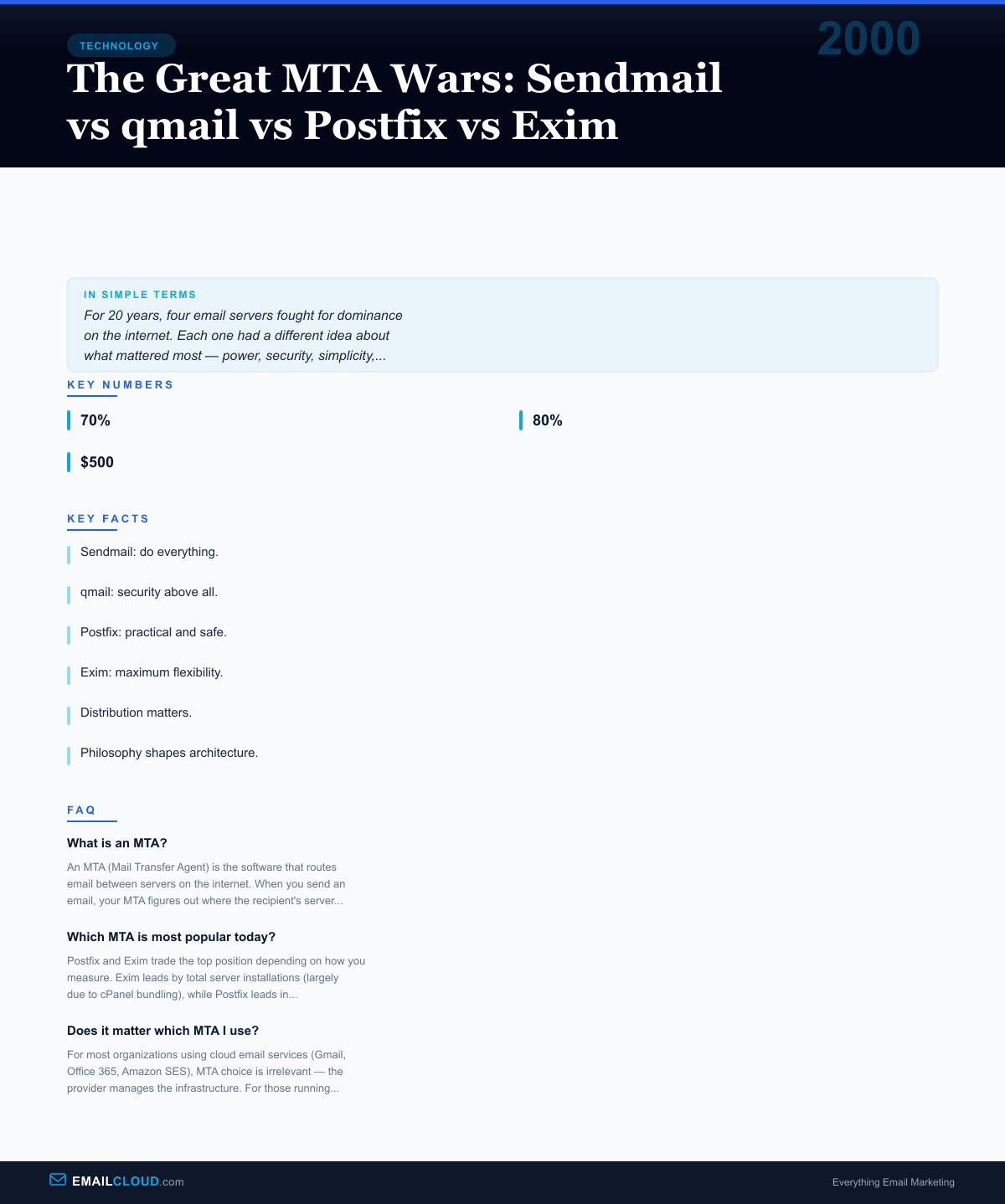
Sendmail: do everything. Eric Allman’s creation was the Swiss Army knife of email. It could handle any mail routing scenario, translate between any protocol, accommodate any address format. Its configuration language was powerful enough to express arbitrary transformations. The cost was complexity so extreme that mastering sendmail.cf was a specialized skill set.
qmail: security above all. Dan Bernstein built qmail with the conviction that a mail server could be provably secure. He sacrificed features, convenience, and even community participation (through his restrictive license) in pursuit of a system that couldn’t be compromised. The result was software of exceptional security and limited adoption.
Postfix: practical and safe. Wietse Venema’s approach was to combine the best ideas from sendmail and qmail into something that was genuinely usable by working administrators. Security through modular architecture, but also compatibility with existing tools and human-readable configuration. Engineering as the art of good trade-offs.
Exim: maximum flexibility. Philip Hazel wanted an MTA where any mail routing policy could be expressed directly in the configuration, without external scripts or code changes. His ACL language gave administrators unprecedented control, at the cost of a larger codebase and a configuration system that required real investment to learn.
These weren’t just different products. They were different answers to the question: what is the purpose of a mail server? Allman said: handle everything. Bernstein said: be impervious. Venema said: be practical. Hazel said: be adaptable.
The Market Share Shift
Through the early and mid-1990s, the competition was largely academic because there was no real competition. Sendmail owned the market. Estimates of its share ranged from 70% to 80% of all internet email traffic. Alternatives existed, but they were marginal.
qmail’s release in 1997 was the first serious challenge. Security-conscious administrators — particularly those at universities, ISPs, and hosting companies who had been burned by sendmail vulnerabilities — began migrating. The Morris Worm of 1988 had used sendmail as one of its propagation vectors, and the steady stream of CERT advisories through the 1990s had eroded confidence. qmail’s $500 security bounty and its adoption by Yahoo Mail gave it credibility that mere technical arguments couldn’t.
But qmail’s growth was constrained by Bernstein’s licensing. You couldn’t distribute modified binaries. Linux distributions couldn’t package it properly. Installing qmail meant downloading source code, fetching patches from third-party sites, and compiling manually. In a world where apt-get install was becoming the standard for software installation, this was a significant handicap.
Postfix and Exim arrived in quick succession — Exim in 1995 (though it didn’t gain significant traction until later), Postfix in December 1998. Both were properly licensed for distribution packaging. Both could be installed with a single command on major Linux distributions. Both offered dramatically better configuration experiences than sendmail.
The 2000s saw a rapid redistribution of market share. Sendmail’s dominance eroded year by year as administrators migrated to Postfix or Exim. New server deployments overwhelmingly chose one of the newer alternatives. Sendmail retained its installed base through inertia — migrating a production mail server is always risky — but each new deployment that chose Postfix or Exim was a permanent loss.
The Flame Wars
Online communities in the late 1990s and 2000s did not lack for strong opinions, and the MTA debate generated some of the most passionate arguments in systems administration forums. The Usenet groups comp.mail.sendmail, comp.mail.misc, and later various web forums became arenas for vigorous — sometimes vicious — advocacy.
qmail enthusiasts were perhaps the most fervent. Bernstein’s uncompromising approach attracted people who shared his contempt for security compromises, and discussions about qmail’s licensing, its handling of edge cases in SMTP compliance, and whether its security bounty was fairly defined could generate hundreds of messages. Bernstein himself was an active and often combative participant in these discussions, which added fuel to fires that were already burning plenty hot.
Postfix advocates tended toward pragmatism, which meant their arguments were less exciting but more persuasive to administrators who just wanted to get email working. “It’s secure, it’s fast, and I can configure it without losing my mind” was a hard pitch to argue against.
Exim users often had the attitude of craftspeople who had chosen a premium tool. The configuration language was powerful, the documentation was excellent, and they could implement mail routing policies that other MTAs couldn’t express without external scripting. The trade-off was complexity, but Exim administrators generally considered that a reasonable price for capability.
Sendmail loyalists grew quieter through the 2000s. Defending sendmail’s security record became increasingly difficult, and the “it handles everything” argument lost force as the other MTAs matured. The most common sendmail defense became “it’s what we already run and it would be risky to migrate,” which was pragmatically sound but rhetorically weak.
The Benchmarks
Performance comparisons between MTAs became a minor cottage industry. Administrators published benchmark results showing their preferred MTA handling more messages per second, using less memory, or recovering from queue backlogs faster than the competition.
The results were, predictably, mixed. On raw throughput, Postfix and qmail generally outperformed sendmail, sometimes dramatically. Exim’s performance varied more with configuration — a well-tuned Exim could match Postfix, but a default configuration with extensive ACL processing was slower. Sendmail’s monolithic architecture made it less efficient under heavy concurrent load.
But benchmarks in email infrastructure are notoriously difficult to make meaningful. Real-world performance depends on DNS lookup speed, disk I/O, network latency, spam filtering overhead, and dozens of other factors that synthetic benchmarks don’t capture. The honest answer was that all four MTAs were fast enough for virtually any deployment if properly configured, and that bottlenecks in production email systems almost always came from somewhere other than the MTA itself.
The Cloud Changes Everything
The MTA wars reached a kind of detente in the 2010s, not because one side won, but because the battlefield shifted. Cloud email services — Gmail for consumers, Microsoft 365 and Google Workspace for businesses, Amazon SES and SendGrid for transactional mail — removed the need for most organizations to run their own mail infrastructure.
When your email is handled by Google’s or Microsoft’s servers, the question of “sendmail vs. Postfix vs. Exim” becomes as relevant as “which brand of postal truck does the post office use?” The answer doesn’t affect your experience. The MTA wars became a concern of infrastructure specialists rather than the broader technology community.
For those who still run their own mail servers — web hosting companies, large enterprises, privacy-conscious organizations, email service providers — the choice still matters. And the current landscape is reasonably clear:
Postfix is the default recommendation for new deployments. Its combination of security, performance, and configurability has made it the consensus choice among systems administrators. It’s the default on macOS and Ubuntu, runs Amazon SES, and is actively maintained by its original creator.
Exim dominates the shared hosting market through cPanel. Its installed base is enormous, and its flexibility makes it well-suited to the complex mail routing requirements of multi-tenant hosting environments. Security concerns persist, but the ecosystem is too established to easily replace.
Sendmail is a legacy presence. It runs on systems where it’s always run, maintained by administrators who know it well and see no reason to risk a migration. New installations are rare. Sendmail, Inc. was acquired by Proofpoint in 2013, effectively ending the commercial venture.
qmail is the least deployed of the four in current installations. Its late licensing liberation and frozen feature development left it unable to compete with actively maintained alternatives. But its security ideas permeate every modern MTA.
What the Wars Taught Us
The MTA wars offer lessons that extend well beyond email infrastructure.
Distribution matters. qmail was arguably the most secure MTA ever written, but its licensing prevented easy distribution and strangled its adoption. Postfix and Exim, with proper open-source licenses and distribution packaging, grew their installed bases effortlessly. Technical excellence is necessary but not sufficient.
Defaults win. Exim became the most deployed MTA not because it won benchmarks or arguments, but because it was bundled with cPanel and defaulted on Debian. In technology, being the default is the strongest market position possible.
Philosophy shapes architecture. The four MTAs’ different philosophies produced genuinely different software. Bernstein’s security obsession produced privilege separation. Venema’s pragmatism produced compatibility layers. Hazel’s flexibility produced a powerful ACL language. The philosophies weren’t interchangeable, and the resulting software reflected its creator’s values.
Nobody ever wins infrastructure wars. All four MTAs are still running. The “war” didn’t produce a single winner — it produced a stable ecosystem where each MTA occupies a niche defined by its strengths. Infrastructure competition tends toward coexistence rather than monopoly.
The SMTP protocol that all four MTAs speak remains unchanged in its fundamentals. The debates about which MTA speaks it best have quieted, but the infrastructure is still there, still routing billions of messages, still running on code whose philosophical foundations were laid in the flame wars of two decades ago.
If you’re setting up email infrastructure today and trying to decide which MTA to use, the honest answer for most situations is Postfix. But we’d encourage you to understand the alternatives — not just for technical reasons, but because the story of how four different philosophies produced four different answers to the same problem is one of the more instructive tales in software engineering.
Infographic
Share this visual summary. Right-click to save.
Related Events
Frequently Asked Questions
What is an MTA?
An MTA (Mail Transfer Agent) is the software that routes email between servers on the internet. When you send an email, your MTA figures out where the recipient's server is, connects to it using SMTP, and delivers the message. Think of it as the postal truck of the digital world.
Which MTA is most popular today?
Postfix and Exim trade the top position depending on how you measure. Exim leads by total server installations (largely due to cPanel bundling), while Postfix leads in cloud deployments and systems where administrators actively choose their MTA. Both far outpace sendmail and qmail in current installations.
Does it matter which MTA I use?
For most organizations using cloud email services (Gmail, Office 365, Amazon SES), MTA choice is irrelevant — the provider manages the infrastructure. For those running their own mail servers, the choice matters for security, performance, and ease of administration. Postfix is the most common recommendation for new deployments today.
Stay ahead of the inbox
Weekly tips on deliverability, automation, and growing your list. No spam, ever.
No spam. Unsubscribe any time. We respect your inbox.