1997: Yahoo Mail: The Rise and Fall of the World's Biggest Email Service
In the late 1990s, Yahoo was the internet. Not a part of the internet — the internet. Yahoo was the homepage, the search engine, the news source, the fantasy sports league, and the email provider for hundreds of millions of people. And at the center of that empire was Yahoo Mail, a free webmail service that would grow to become the single most popular email platform on the planet. The story of Yahoo Mail is the story of a company that had everything — market dominance, brand loyalty, billions of users, and a $44.6 billion acquisition offer — and managed to lose it all.
RocketMail and the Origin Story
Yahoo Mail didn’t start as Yahoo Mail. In 1997, Yahoo acquired Four11 Corporation, a small company best known for its internet white pages directory. But Four11 had a side project that caught Yahoo’s attention: RocketMail, a free webmail service launched in 1996. RocketMail wasn’t the first webmail — that distinction belongs to Hotmail, which launched in July 1996. But RocketMail was solid, functional, and available for acquisition.
Yahoo absorbed RocketMail, rebranded it as Yahoo Mail, and integrated it into the Yahoo portal. The timing was perfect. The web was exploding, millions of people were coming online for the first time, and they needed an email address. Yahoo was already the most visited site on the internet. Adding free email to that ecosystem was like adding a gas station to a highway rest stop — of course people were going to use it.
By 1999, Yahoo Mail had tens of millions of users. By 2000, it was the most popular webmail service in the world. The AOL era was fading, Hotmail had been acquired by Microsoft and folded into MSN, and Yahoo Mail was the default email for a generation of internet users.
The Storage Wars
For most of its early life, Yahoo Mail offered a modest amount of free storage — 4 MB initially, eventually growing to 100 MB by the early 2000s. That was fine when emails were mostly text. But as attachments grew larger and people started using email for photo sharing, storage limits became a daily frustration. Users constantly had to delete emails to stay under the cap.
Then Google changed everything. When Gmail launched in April 2004 with 1 GB of free storage — 100 times what Yahoo offered — it sent shockwaves through the webmail industry. The invitation-only rollout created artificial scarcity that made Gmail feel exclusive, and the generous storage made everyone else look stingy.
Yahoo responded quickly, bumping its free storage to 100 MB, then 250 MB, then 1 GB to match Gmail, and eventually offering “unlimited” storage in 2007. But the damage was done. Gmail had seized the narrative. Yahoo Mail was now playing catch-up to a product that was only a few months old, and that repositioning — from leader to follower — would define Yahoo’s trajectory for the next decade.
The $44.6 Billion Mistake
In February 2008, Microsoft made an unsolicited offer to acquire Yahoo for $44.6 billion, or $31 per share — a 62% premium over Yahoo’s closing price the day before the offer. Microsoft CEO Steve Ballmer wanted Yahoo’s search business to compete with Google, but the acquisition would have also given Microsoft control of Yahoo Mail and its hundreds of millions of users.
Yahoo CEO Jerry Yang rejected the offer. He believed Yahoo was worth more. The board backed him — at least initially. Yang counter-proposed at $37 per share. Microsoft walked away.
What followed was a slow-motion disaster. Yahoo’s stock price cratered. Shareholders revolted. Carl Icahn launched a proxy fight to replace the board. Yang was forced to resign as CEO in November 2008. The parade of replacement CEOs began — Carol Bartz (fired by phone in 2011), Scott Thompson (resigned after a resume scandal in 2012), and finally Marissa Mayer, who arrived from Google in 2012 with a mandate to fix everything.
Mayer spent aggressively — acquiring Tumblr for $1.1 billion, redesigning products, hiring thousands of engineers. Yahoo Mail got a redesign. None of it reversed the fundamental decline. By the time Yahoo finally sold its internet business in 2017, the price was $4.48 billion — roughly one-tenth of what Microsoft had offered nine years earlier. The rejected Microsoft bid is routinely cited as one of the worst business decisions in corporate history.
The Breaches That Destroyed Trust
If the Microsoft rejection was Yahoo’s worst business decision, the data breaches were its worst security failure. In August 2013, hackers breached Yahoo’s systems and stole data from what the company would eventually acknowledge was all 3 billion user accounts — every Yahoo account that existed. Names, email addresses, phone numbers, dates of birth, hashed passwords (using the weak MD5 algorithm), and in many cases, unencrypted security questions and answers.
Yahoo didn’t disclose the breach until December 2016 — more than three years later — and initially claimed only 1 billion accounts were affected. The full scope of 3 billion accounts wasn’t revealed until October 2017. It remains the largest data breach in history.
A separate breach in 2014, attributed to Russian state-sponsored hackers, compromised 500 million additional accounts. The U.S. Department of Justice later indicted two FSB officers in connection with that attack.
The breach disclosures landed squarely in the middle of Yahoo’s sale to Verizon, which had agreed to pay $4.83 billion. Verizon renegotiated, reducing the price by $350 million. The breaches also triggered SEC fines, class-action lawsuits, and a mass exodus of users who no longer trusted Yahoo with their data.
The Verizon Era and Beyond
Verizon’s acquisition closed in June 2017. Yahoo Mail was folded into a new subsidiary called Oath, alongside AOL’s properties (Verizon had acquired AOL in 2015 for $4.4 billion). Oath was later rebranded to Verizon Media, which was then sold to Apollo Global Management in 2021 for $5 billion. The combined entity was renamed Yahoo — bringing the brand full circle, now under private equity ownership.
Through all of this corporate turbulence, Yahoo Mail persisted. The service was redesigned multiple times, gained features like disposable email addresses and mailbox organization tools, and continued to function as a perfectly adequate webmail platform. By 2025, Yahoo Mail still claimed over 225 million monthly active users — a fraction of Gmail’s dominance, but not insignificant.
The Lesson of Yahoo Mail
Yahoo Mail’s story is ultimately about squandered advantage. The service had first-mover benefits (after Hotmail), the largest user base, massive brand recognition, and the financial resources to innovate. But Yahoo treated email as one feature among many in its portal strategy, rather than as the core product that kept users in the ecosystem.
Google understood what Yahoo didn’t: that email was the anchor of a user’s digital identity. Gmail wasn’t just a mail client — it was the login for YouTube, Google Drive, Google Calendar, Android, and eventually an entire cloud ecosystem. Yahoo Mail was a feature of a portal. Gmail became the foundation of a platform.
For email marketers, the Yahoo Mail story offers a practical lesson as well. Yahoo Mail users still represent a significant segment of most email lists. Yahoo’s spam filtering, authentication requirements, and deliverability quirks differ from Gmail’s, and ignoring them means ignoring a meaningful portion of your audience. Understanding the email client landscape isn’t optional — it’s the difference between reaching your subscribers and landing in their spam folder.
Infographic
Share this visual summary. Right-click to save.
Related Events
Frequently Asked Questions
When did Yahoo Mail launch?
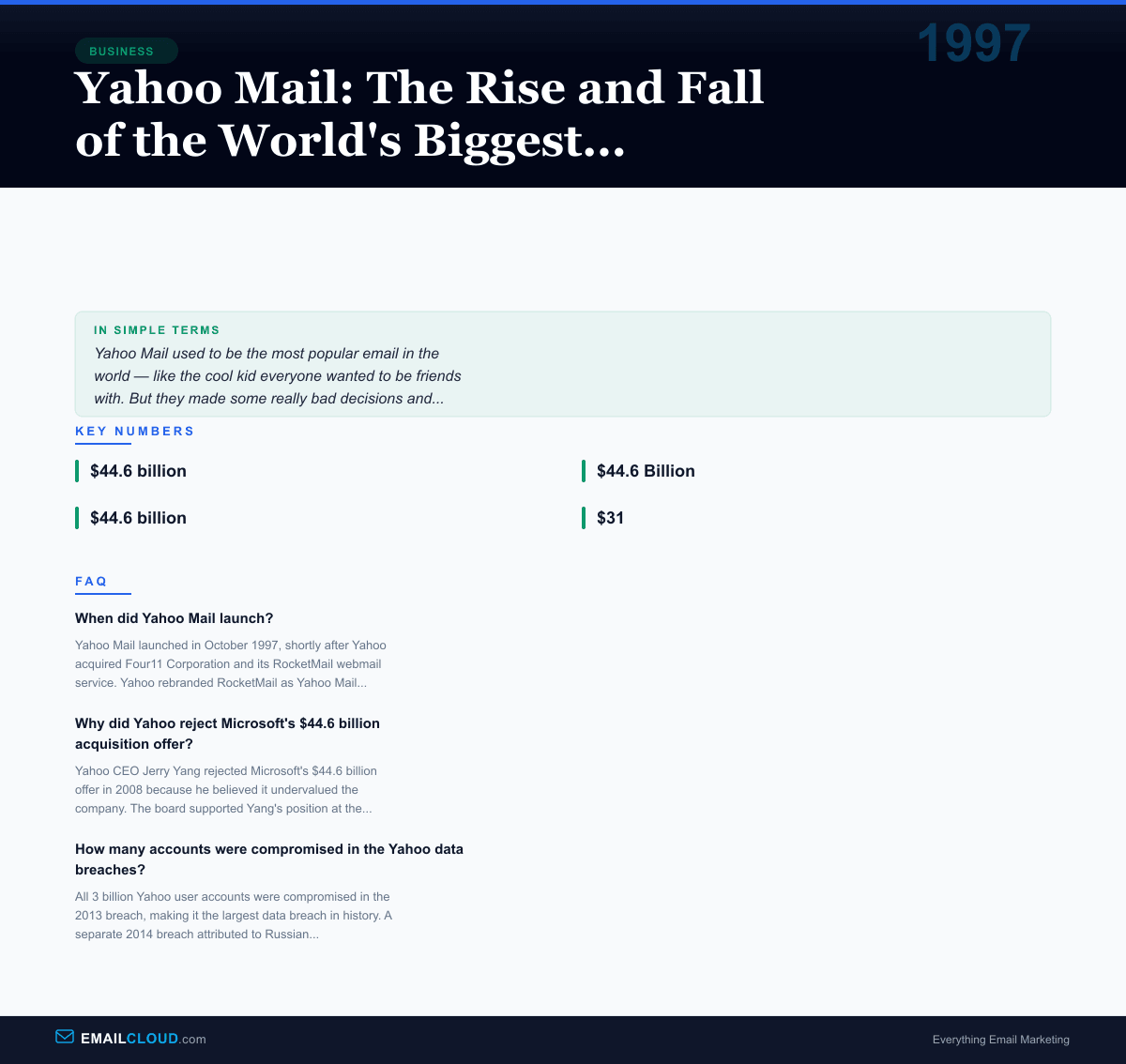
Yahoo Mail launched in October 1997, shortly after Yahoo acquired Four11 Corporation and its RocketMail webmail service. Yahoo rebranded RocketMail as Yahoo Mail and integrated it into its portal ecosystem, quickly growing it into the world's most popular webmail service.
Why did Yahoo reject Microsoft's $44.6 billion acquisition offer?
Yahoo CEO Jerry Yang rejected Microsoft's $44.6 billion offer in 2008 because he believed it undervalued the company. The board supported Yang's position at the time. The decision is widely considered one of the worst in corporate history — Yahoo eventually sold to Verizon in 2017 for just $4.48 billion.
How many accounts were compromised in the Yahoo data breaches?
All 3 billion Yahoo user accounts were compromised in the 2013 breach, making it the largest data breach in history. A separate 2014 breach attributed to Russian state-sponsored hackers affected 500 million accounts. Together, these breaches devastated user trust and cost Yahoo $350 million in its Verizon acquisition price.
Stay ahead of the inbox
Weekly tips on deliverability, automation, and growing your list. No spam, ever.
No spam. Unsubscribe any time. We respect your inbox.